
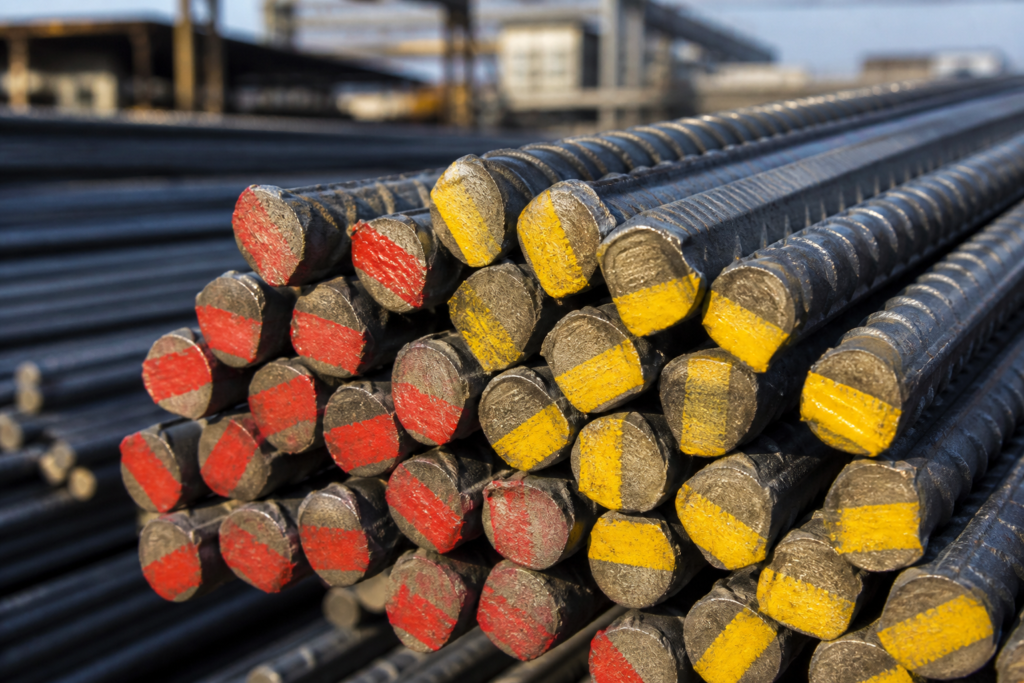
Construction Steel Bar Standards: GB vs ASTM vs EN Compared?
Your concrete frame fails silently when bar standards are mismatched. Choosing correctly between GB, ASTM and EN protects every pour.
GB/T 1499.2, ASTM A615/A615M and EN 10080 differ mainly in grade names, yield-strength units, test packages, rib geometry and marking; they are close but never interchangeable without the engineer’s approval.
Behind those three labels sit three different philosophies: a Chinese national system, an American material specification and a European ductility-class framework. This guide maps each family, translates the grades across borders, compares the tests and markings that inspectors will check, and ends with a specification checklist that importers can send straight to a supplier.
Which Standard Families Govern Construction Steel Bar Today?
Procuring rebar across borders means decoding three parallel standards systems. Confusion over which governs your order can stall inspection and customs. Here is the map.
China specifies hot-rolled ribbed bars in GB/T 1499.2; North America uses ASTM A615/A615M, with A706 for weldable and seismic work; Europe and most international contracts use the EN 10080 framework through national standards such as BS 4449, while ISO 6935-2 serves as the cross-border reference.
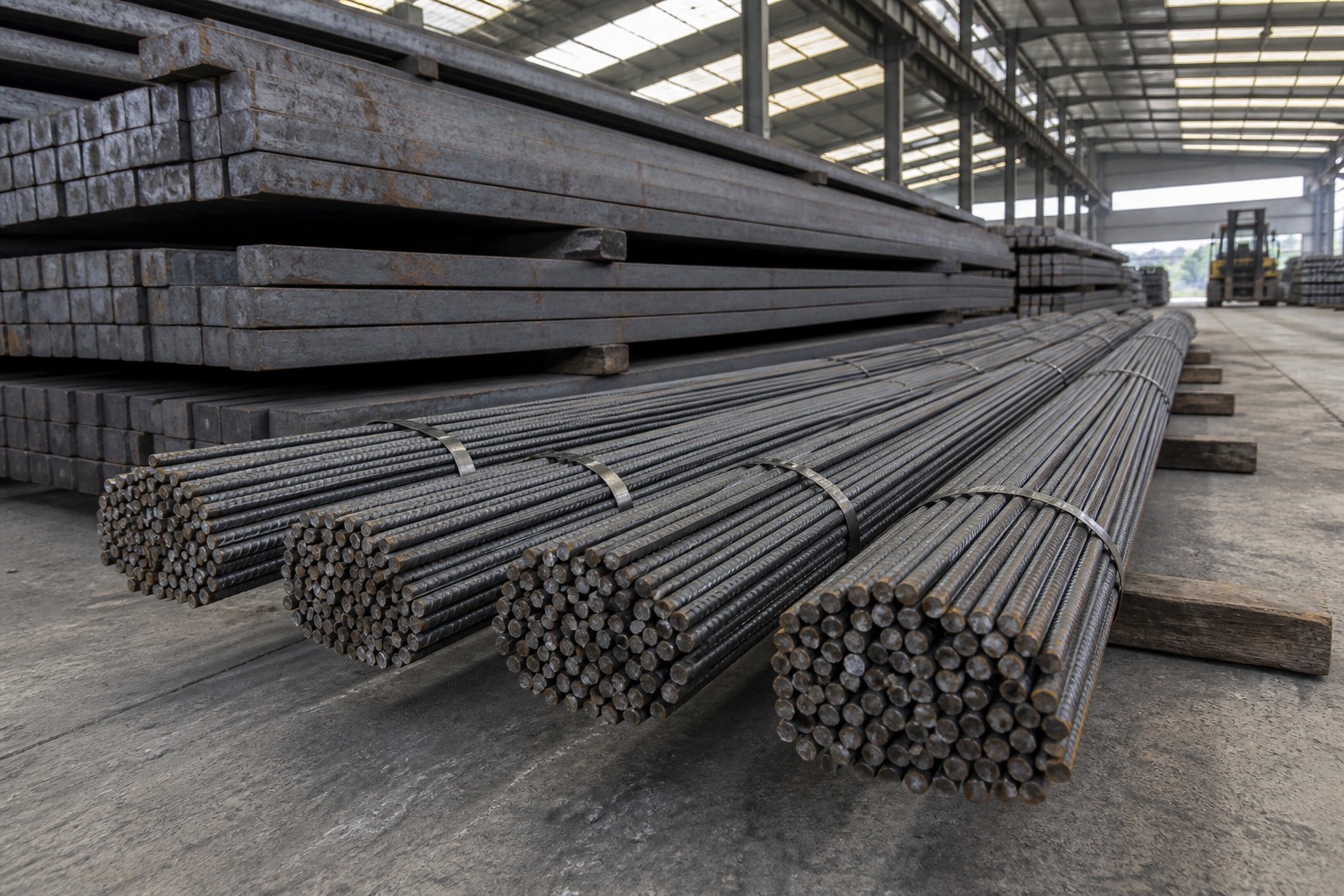
Every deformed bar you buy is produced to one of these families, and the family name on the order decides which tests apply, which marks are rolled into the steel, and which certificate the shipment must carry. The product itself, as rebar is defined in engineering practice, is the same ribbed hot-rolled steel; the standards describe how that steel must behave. GB/T 1499.2, published by China’s national standardization body as part of the GB/T recommended series, governs hot-rolled ribbed bars for the reinforcement of concrete. Its mainstream structural grades are HRB400 and HRB500, where the number states the guaranteed yield strength in MPa, and the letter E (HRB400E, HRB500E) marks variants with stricter seismic ductility requirements. Plain round bars for light reinforcement sit in the companion standard GB/T 1499.1. Chinese-standard rebar travels far beyond China: it is the default specification on Chinese-funded infrastructure and in many Asian and African markets where project documentation is written to GB/T.
The second family, ASTM A615/A615M, is a material specification rather than a national building code. Published by ASTM International, it covers deformed and plain carbon-steel bars in cut lengths and coils, and it names grades by minimum yield strength in ksi with the SI value shown in brackets: Grade 40 [280 MPa], Grade 60 [420 MPa], Grade 80 [550 MPa] and Grade 100 [690 MPa]. Two companion documents complete the picture: ASTM A706, which adds tight chemistry limits so the bars are weldable and suitable for seismic applications, and ASTM A615’s own provisions for ordering, testing and marking, which we examine below. North American structural concrete design, and with it most projects in the Americas and the Middle East, is written around these grade names, and the bars are ordered in imperial bar numbers (No. 3 to No. 18) that correspond only approximately to metric diameters.
The third family is European. EN 10080, the framework standard for steel for the reinforcement of concrete, was never fully harmonised for CE marking, so the enforceable requirements live in national standards, the best known being BS 4449 in the United Kingdom and Ireland. European grades are ordered as B500A, B500B or B500C: the 500 states a 500 MPa characteristic yield strength and the letter is the ductility class, with B500B the general structural default and B500C reserved for seismic detailing. Because the same framework is widely quoted in international contracts, suppliers in Asia routinely certify against it alongside their national standard, and ISO 6935-2, the international standard for ribbed bars for the reinforcement of concrete, is the neutral reference used when a contract names no national system. For the product background behind these documents – rib geometry, bond to concrete and how grades are named – see our construction steel bar standards and grades guide.
How Do GB, ASTM and EN Grade Names and Strengths Map to Each Other?
Grade names look unrelated, yet each encodes one core promise: minimum yield strength. Translating that promise is the first step in any cross-standard order.
HRB400 means 400 MPa minimum yield; ASTM Grade 60 means 60,000 psi, about 420 MPa; B500B means 500 MPa characteristic yield. HRB500, Grade 80 at 550 MPa and B500C sit at the top of the common range.
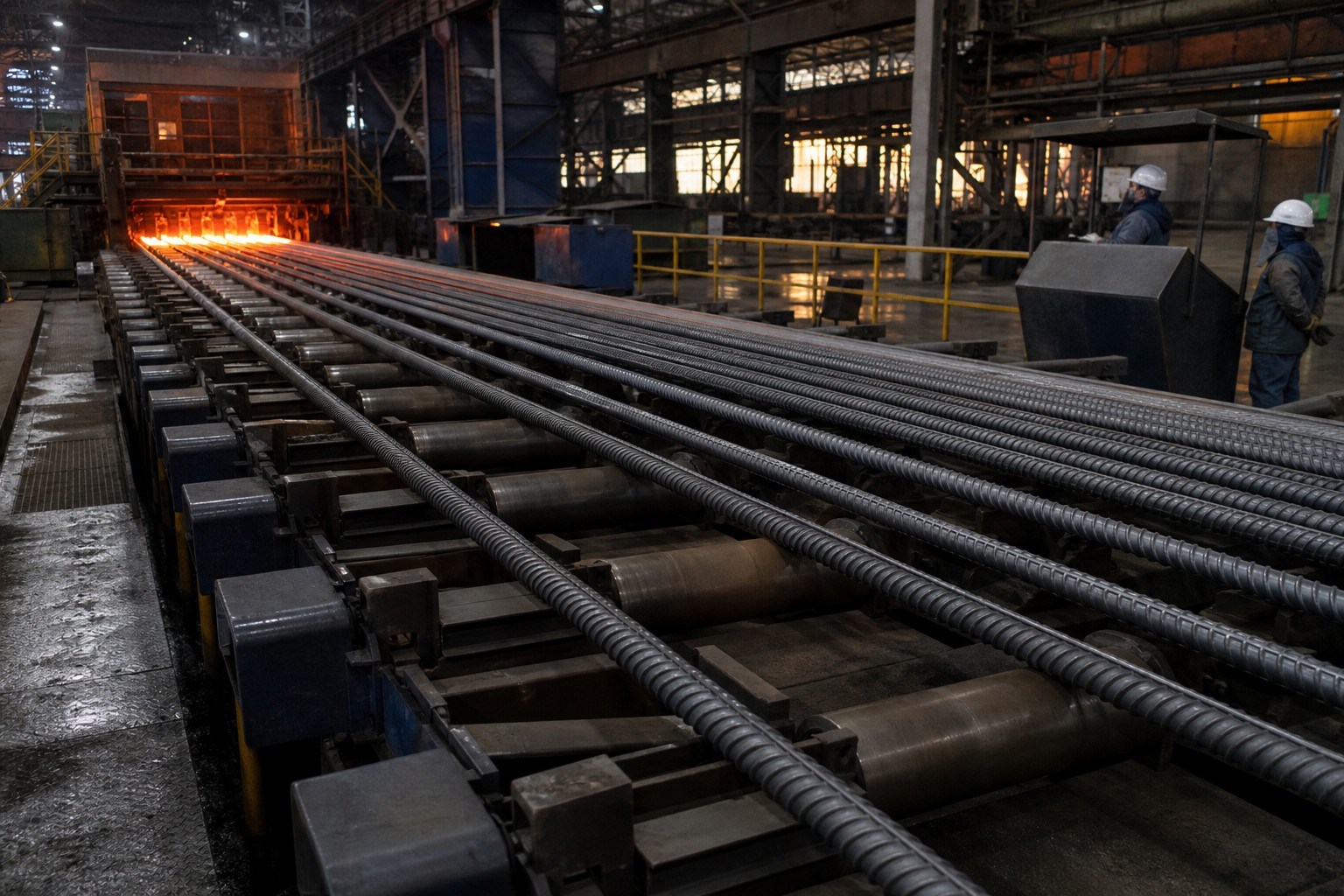
The quickest way to compare grades is a translation table, because the yield strength is the property that structural designers actually use. The values below are the published minimums or characteristic values from each standard family, stated in MPa for direct comparison:
| Standard family | Grade | Minimum yield strength | Typical use |
|---|---|---|---|
| GB/T 1499.2 (China) | HRB400 / HRB400E | 400 MPa | General structures; E variant for seismic zones |
| GB/T 1499.2 (China) | HRB500 / HRB500E | 500 MPa | Heavy columns and high-load members |
| ASTM A615/A615M (USA) | Grade 60 [420] | 420 MPa (60,000 psi) | Default structural grade in the Americas |
| ASTM A615/A615M (USA) | Grade 80 [550] | 550 MPa (80,000 psi) | High-rise and heavily loaded members |
| EN 10080 / BS 4449 (Europe) | B500B | 500 MPa (characteristic) | General structural use |
| EN 10080 / BS 4449 (Europe) | B500C | 500 MPa (characteristic) | Seismic and high-toughness detailing |
Three traps hide inside this table. First, units: ASTM states yield in ksi and MPa together, GB/T and EN state it in MPa, and one newton per square millimetre equals one MPa, so “N/mm²” on a European certificate is the same unit under another name. Second, ductility: the yield number alone does not describe the bar. The HRB400E suffix adds a tensile-to-yield strength ratio and total elongation requirements so the bar yields and deforms in a controlled way before it breaks, and the European class letters do the same job, with class C demanding the highest elongation at maximum force. A higher yield grade is therefore not automatically the right bar for an earthquake zone; ductility behaviour is what the seismic design relies on. Third, tensile strength: every standard also sets a minimum tensile strength above yield, roughly 620 MPa for Grade 60, which is what the bar can actually carry at ultimate load. To confirm which grades, diameters and lengths are available to each standard for your project, review the rebar standards and sizes range at Shuncheng Steel.
What Do GB, ASTM and EN Testing Requirements Differ On?
Two bars with the same grade mark can still fail differently if the test packages differ. Inspection starts with knowing what each standard actually checks.
All three families verify chemical composition, tensile properties, cold bend behaviour and rib geometry, but they differ in sampling frequency, the detail of the deformation requirements, and how the certificate must report each heat.
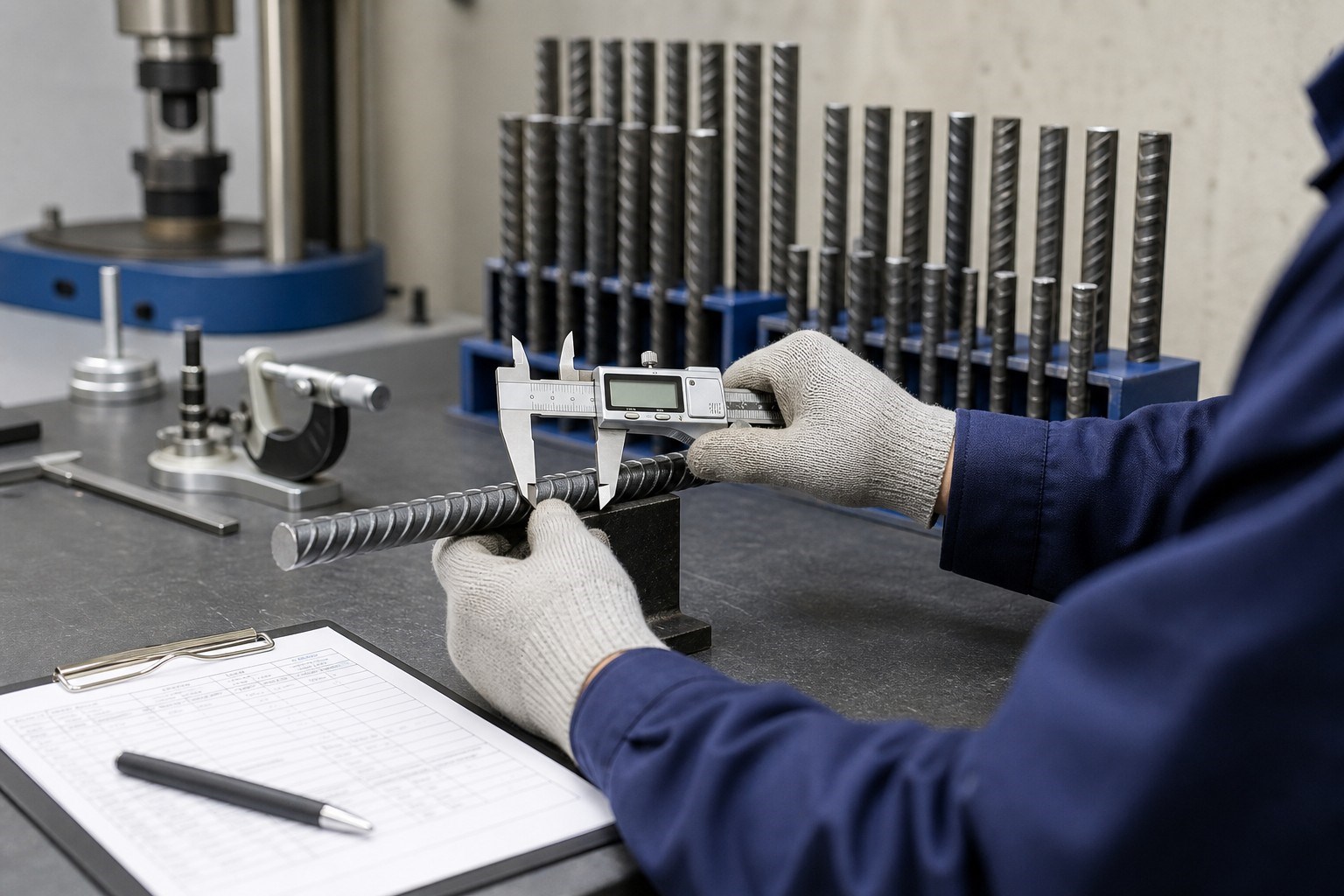
The test pyramid is similar in every family, and it starts with the melt. The ASTM A615/A615M specification requires a heat analysis confirming the limits on carbon, manganese, phosphorus and sulphur, because those elements control both the strength that the designer assumes and the weldability that the fabricator may need. From each heat and lot, samples are then taken for tensile testing, which records yield strength, tensile strength and elongation, and for bend testing, in which a full-size bar is bent cold around a former of specified diameter and must show no cracks on the tension face. GB/T 1499.2 follows the same logic for HRB grades: a heat analysis, tensile and bend tests per batch, plus reverse-bend testing for the seismic E grades, and rib geometry checks against the dimensional tolerances in the standard. ISO 6935-2, which we linked in the first section, mirrors this structure so that a mill can certify one production run against several standards and issue one coherent test report.
Where the families genuinely differ is in the detail and the paperwork. ASTM A615 sets explicit deformation requirements, meaning the height and spacing of the ribs must fall inside measured tolerances because the ribs, not the chemistry, create the bond with concrete. The edition year matters as much as the designation: A615/A615M is revised periodically, and a certificate stating only “ASTM A615” without the year is an incomplete statement. GB/T 1499.2 certificates are commonly bilingual, with the heat number, grade, diameter and mechanical results on a mill test certificate that must trace back to the rolled-in marks. European orders are almost always documented with an EN 10204 type 3.1 inspection certificate, which adds the mill’s independent quality statement that the material meets the order specification. For buyers the practical rule is simple: name the standard, the edition year and the grade in the order, then require a certificate that reports the heat number, the chemical analysis and the tensile and bend results. Any certificate that cannot tie a bundle to a heat number is not worth the paper it is printed on, and that is the single most common cause of rebar rejection at destination inspection. Industry quality publications from the Concrete Reinforcing Steel Institute (CRSI) give inspectors and fabricators the reference guidance for evaluating delivered bars against these documents.
How Do Marking and Traceability Requirements Differ?
Certificates travel with the paperwork, but the bar itself must carry its identity. Marking rules decide whether your inspector can verify the steel on the ground.
Every major standard requires the producer’s identity and the grade to be rolled into the bar surface and repeated on bundle tags, but the marking detail is prescribed much more strictly in some systems than in others.
Marking exists because reinforcement is installed in hundreds of tonnes, mixed across suppliers on a single site, and buried in concrete where it cannot be re-checked after the pour. If a bundle cannot be identified on the ground, a wrong grade can be fixed into a structure and discovered only years later. The three families approach the problem at different levels of prescription. ASTM A615 is the most detailed: bars must carry the producer’s mill symbol, a bar size designation and a grade mark rolled continuously along the bar, using a system of longitudinal lines whose number identifies the grade, so that an inspector can read the grade from the side of the bar without a certificate in hand. GB/T 1499.2 similarly requires grade identification rolled into the bar, with the grade name such as HRB400 or HRB500 and the manufacturer’s mark, and bundles are tagged with the heat number, diameter, quantity and production date so each bundle can be matched to its certificate. European national standards such as BS 4449 define their own marking schemes, typically combining a mill identifier, a grade identifier and a country or standard code, and the full traceability chain is carried by the 3.1 certificate rather than by marks alone.
What an importer should actually verify at destination is a short checklist: the rolled marks must match the grade on the order; the bundle tags must show a heat number that appears on the certificate; the diameter must measure within tolerance rather than merely looking right; and the number of bars in each bundle should be reconciled against the theoretical weight on the packing list. Mixing two grade families in one container is common when orders are consolidated, so bundles from different standards should be separated and tagged clearly before loading, and the discrepancy between mill marks and paperwork is a legitimate reason to hold the shipment for third-party inspection. Traceability is also your legal protection: if a complaint arises months later, the heat number on the tag is the only route back to the melt, the test results and the responsible mill.
Can GB, ASTM or EN Rebar Be Substituted on the Same Project?
“Equivalent strength” sounds safe, but codes are written around one standard. Substituting across families without approval is where structures go out of specification.
Replacement is allowed only when the engineer confirms the bars satisfy the project code – same yield class, same ductility behaviour, compatible sizes and approved detailing; treating 400 MPa, 420 MPa and 500 MPa grades as freely swappable is a costly error.

The temptation to substitute is real because prices differ by grade and by market, but reinforced concrete design is code-based, not strength-based. A US project designed to ACI 318 expects bars to ASTM A615 with sizes expressed in imperial bar numbers; a European project designed to Eurocode 2 expects B500 reinforcement to the national EN standard; a Chinese project designed to GB 50010 expects HRB grades to GB/T 1499.2. The development length, lap length and splice details in the drawings were calculated using the bond properties and ductility of the specified bar, not of a “similar” grade from another family. Rib patterns differ between standards, which changes bond and therefore changes the anchorage the engineer assumed; the metric diameters of GB/T and EN bars do not exactly match the imperial sizes of ASTM bars, so a No. 5 bar is not the same physical product as a 16 mm bar even though both are commonly called out in similar situations; and in seismic zones the ductility class is the deciding property, so an HRB400 without the E suffix or a B500A where the design says B500C is simply the wrong bar regardless of its yield number.
Welding is a second hidden constraint. The ASTM A615 specification itself cautions that its carbon-steel chemistry is not specifically formulated for weldability and that any welding should follow an approved procedure such as AWS D1.4, which is why project specifications that require welded splices usually call for ASTM A706 instead. European B500 grades are weldable reinforcing steels by design, and Chinese HRB grades are weldable within procedure limits, but every weld changes the local metallurgy, so the grade family chosen must match what the drawings permit. If a substitution is genuinely necessary, the safe path is: obtain the engineer’s written approval before production, confirm the equivalent grade on the certificate, re-check the splice and anchorage details, and keep the substituted material segregated and clearly documented so it is never mixed into the next pour. The practical grade-level differences behind this decision, including HRB versus B500 behaviour, are broken down in this rebar standards comparison article.
How Should Importers Specify Rebar to the Right Standard?
Most rebar order errors happen before the order exists. A specification that names one standard, clearly and completely, prevents almost all of them.
State the governing code, the supply standard with its edition year, the grade including any seismic suffix, the diameter system, the length, the certificate type and the inspection requirement; then confirm each of those points in writing with the mill.
A complete rebar inquiry reads like a small contract, and it should, because every ambiguity in it will be resolved by someone later at a cost you pay. The checklist below is what the Shuncheng Steel sales team uses to convert an inquiry into a firm offer, and it works with any supplier:
- Governing code and standard. Name the design code (ACI 318, Eurocode 2, GB 50010 or the local code) and the supply standard with the edition year, for example GB/T 1499.2-2024, ASTM A615/A615M-20 or BS 4449. A grade without a standard is meaningless.
- Grade and ductility. Write the full designation, including the seismic suffix or ductility class where it applies: HRB400E, Grade 60, B500C and so on. State the required yield strength in MPa if the project documentation uses SI units.
- Diameter and length. Use the diameter system of the standard you chose: metric millimetres for GB/T and EN practice, bar numbers for ASTM projects. Specify length – 6 m, 9 m or 12 m are the common export lengths – and confirm what fits your container plan.
- Quantity and units. Order in tonnes with the diameter, theoretical weight per metre and piece count reconciled, so that the shipment can be verified by weighing on arrival.
- Certificates and inspection. Require the mill test certificate with heat numbers, chemical analysis and mechanical results, an EN 10204 type 3.1 certificate for European-standard orders, and state whether third-party inspection (SGS, BV or similar) is required before loading.
- Marking, bundling and surface. Agree on bundle weights, tagging and separation by heat, and accept that light surface oxidation from transit is normal while heavy rust or pitting is a rejection condition.
Lead time deserves the same level of detail as the steel itself. A mill that keeps common grades such as HRB400 and Grade 60 in stock can often roll, test and load within weeks, while less common diameters, seismic grades or long production runs must be scheduled against the rolling plan, so the inquiry should state the required delivery window and the destination port. Third-party inspection, when it is required, adds days at both the mill and the destination, and the inspection standard should be named in the order so that the inspector checks the same properties the contract promises. Finally, agree the basis of the price in the inquiry – ex-works, FOB or CIF – because freight and insurance often differ between suppliers by more than the steel itself, and a landed-cost comparison is the only honest way to compare two quotations that name the same grade and standard.
With these points fixed, a mill can quote accurately, test correctly and load a shipment that passes inspection on arrival. Shaanxi Shuncheng Tian Steel Co., Ltd. is a direct mill exporter supplying deformed bars in HRB400, HRB500, ASTM and European grade designations, and its export range spans 6 mm to 36 mm in 6 m, 9 m and 12 m lengths. To turn this specification into a firm quotation, send your size list with the standard, grade and destination to contact Shuncheng Steel’s sales team, and the reply will confirm availability, certification and the most economical bundling and container plan for your project. Where the inquiry settles on a specific heavy size, such as the HRB500 deformed steel bar in 28 mm, confirm the governing standard and certificate language in the same message.
Conclusion
GB, ASTM and EN rebar are engineering cousins, not twins. Match the standard your design code names, verify certificates and markings, and buy from a mill that documents compliance.