
High-Pressure Boiler Steel Pipe: What Standards Apply and Where Is It Used?
Specify the wrong boiler tube and a single failure can force an outage. Seamless boiler steel pipe must be matched to its standard, duty and certificate before you order.
High-pressure boiler steel pipe is seamless carbon, alloy or stainless tube made to pressure-equipment standards such as ASTM A106, A210/A210M, A192, A213, GB 5310 and EN 10216-2. It carries steam and hot water in power-plant boilers, superheaters, reheaters and process plants.
Those standards differ in chemistry limits, wall-thickness tolerance, heat treatment and the test package that ships with the pipe. This guide explains what each one covers, how the tube is manufactured, which tests prove its quality, where it is used, and how to specify size, grade and schedule so that your inquiry and your mill certificate match the job.
What Is High-Pressure Boiler Steel Pipe, and Where Is It Used?
A boiler is a closed vessel in which water is heated into steam. Its tubes form the pressure boundary, and tougher service demands a stricter tube specification.
Boiler steel pipe is the seamless tube inside a boiler’s steam-generating, superheating and reheating circuits. It is specified wherever steam at elevated pressure and temperature must be contained inside a uniform, weld-free wall for years of continuous operation.
The service envelope defines the product
What separates boiler tube from ordinary pipe is not the outside diameter but the combination of pressure, temperature and continuity of service. Modern power-generating boilers are almost entirely water-tube designs, in which water circulates inside tubes heated externally by combustion gas. The water-tube arrangement allows far higher pressures than the older fire-tube design, because the pressure is contained in relatively small-diameter tubes with comparatively thin walls rather than in one large shell; fire-tube boilers are rarely used above roughly 2.4 MPa (350 psi) for exactly that structural reason. As one authoritative reference on water-tube boiler design records, large utility units operate with steam flows approaching 500 kg/s at pressures around 16 MPa (about 160 bar) and temperatures reaching 550 °C at the outlet of the superheating circuit.
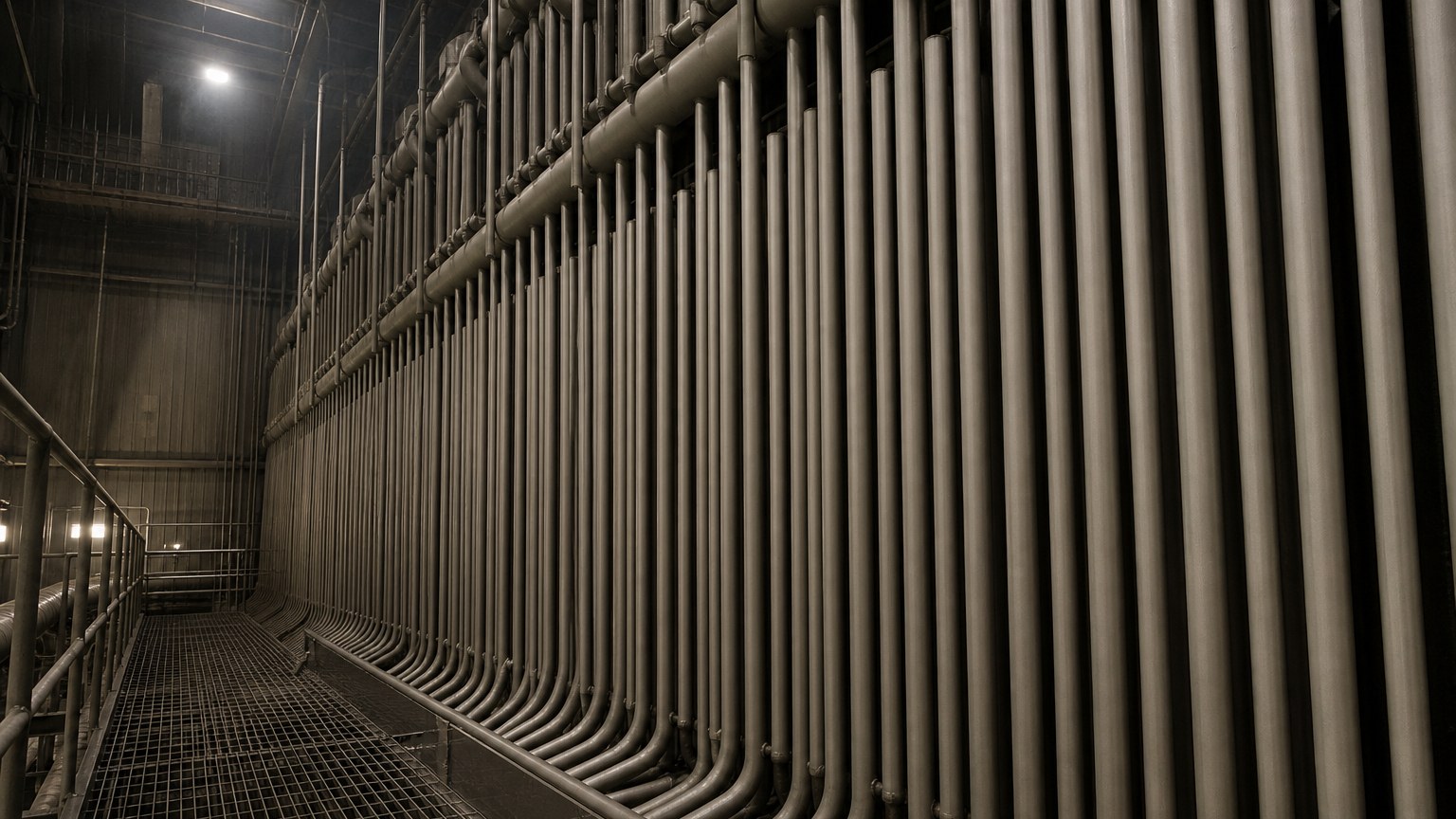
Two consequences follow. First, the tube must retain adequate creep strength at temperature, not merely tensile strength at room temperature — a property governed by chemistry and heat treatment, and therefore by the specification you buy against. Second, the tube must be dimensionally consistent around its whole circumference, because a locally thin wall becomes the limiting point for the entire pressure envelope. This is why high-pressure boiler steel pipe supplied in seamless form remains the default for boiler circuits: there is no longitudinal weld seam and therefore no heat-affected zone whose properties have to be separately proven. In a water-wall, economizer, superheater or reheater bank, hundreds of individual tubes are welded end to end, so every metre of tube enters the pressure boundary and any weak point is a system risk rather than a local defect.
Follow the steam path through a power station and the duty changes with every stage. In the furnace, water-wall tubes form the enclosure itself, absorbing radiant heat while containing boiling water. In the economizer, tubes preheat feedwater using exhaust gas that would otherwise be wasted. In the superheater, steam is heated beyond its saturation temperature so that it arrives at the turbine dry; the flue-gas path in that zone reaches roughly 1,300–1,600 °C, and the superheater absorbs that heat by radiation, convection or a combination of both, which is why alloy grades with elevated-temperature strength are usual there. In the reheater, steam returning from the high-pressure turbine is reheated before re-entering the intermediate-pressure stages, improving cycle efficiency. Steam headers and main steam piping then distribute the flow at full pressure and temperature.
Combined-cycle plants add a further application: the heat-recovery steam generator, which raises steam from the exhaust of a gas turbine without burning additional fuel. HRSG tube banks operate under cyclic duty — daily start-ups and load swings — so thermal fatigue resistance and consistent wall thickness matter as much as peak strength. The process industries repeat a narrower version of the same picture. Chemical and refining plants circulate high-temperature steam for reactors, reboilers and tracing lines; pulp and paper mills need both process steam and recovery-boiler tube; and any facility running a package boiler for heating or sterilisation needs tube matched to its design pressure and temperature rather than the cheapest pipe available.
What these applications share is that replacement is planned maintenance, not emergency repair. A tube bank that fails in service forces an outage far more expensive than the tube itself, which is why a specification normally leads with the design code’s requirements and the standard that satisfies them, rather than with price per ton.
Which Standards Govern Boiler Steel Pipe Around the World?
Boiler tube standards are not interchangeable. Each fixes its own chemistry, mechanical limits, tolerances and test package, and those differences decide which one your design code accepts.
The main families are ASTM A106, A179, A192, A210/A210M and A213 for seamless boiler, superheater and heat-exchanger tubes, GB 5310 for China, and EN 10216-2 for European pressure equipment. The design code then governs how they are used.
How the main boiler tube standards differ
The table below summarises the scope of the standards most often quoted on international boiler tube inquiries. Grade designations and scopes follow the published standards; always confirm the current edition and any project-specific addendum before ordering.
| Standard | Product scope | Typical grades | Usual service |
|---|---|---|---|
| ASTM A106 / ASME SA-106 | Seamless carbon steel pipe for high-temperature service | A, B, C | Steam headers, high-temperature process and steam piping |
| ASTM A210 / A210M | Seamless medium-carbon steel boiler and superheater tubes | A-1, C | Boiler tubes, superheater elements, flues and stay tubes |
| ASTM A179 | Seamless cold-drawn low-carbon steel heat-exchanger and condenser tubes | Single grade | Heat exchangers, condensers, low-temperature tube banks |
| ASTM A192 | Seamless carbon steel boiler tubes for high-pressure service | Single grade | Boiler water walls and high-pressure boiler tubes |
| ASTM A213 / ASME SA-213 | Seamless ferritic and austenitic alloy-steel boiler, superheater and heat-exchanger tubes | T11, T22, T91 and related grades | Superheaters, reheaters and high-temperature tube banks |
| GB 5310 | Seamless steel tubes for high-pressure boilers | 20G and companion grades | Power-plant boilers in the Chinese market and export projects specifying GB |
| EN 10216-2 | Seamless steel tubes for pressure purposes, with specified elevated-temperature properties | Non-alloy and alloy pressure grades | European pressure equipment and boiler circuits |
The American Society of Mechanical Engineers publishes the rules that most of these tubes are eventually designed and certified against. The ASME Boiler and Pressure Vessel Code governs the design, fabrication, inspection, testing and certification of boilers and pressure vessels, and has grown from a single volume in its first edition into a multi-section code applied in more than a hundred countries. For power boilers specifically, Section I sets the construction rules, while the material sections list which tube specifications may be used and under what temperature limits.
In practice, three reading skills separate a smooth order from a rejected one. First, check whether the specification is seamless by definition or permits welded construction — several boiler tube standards are written for seamless product, so a welded offer is a different product even when the grade name matches. Second, check the temperature scope: a standard written for high-temperature service carries different chemistry and test requirements from one written for heat-exchanger duty at moderate temperature. Third, check the test package — hydrostatic or nondestructive electric testing, flattening, flaring, hardness and tension tests are specified by standard, and a certificate that omits them is incomplete regardless of how the pipe performs in the yard.
It also helps to recognise how the Chinese and European families map onto the American ones when you compare quotations. GB 5310 covers seamless tubes for high-pressure boilers and is the standard behind commonly quoted boiler grades such as 20G, while EN 10216-2 governs seamless tubes for pressure purposes with specified elevated-temperature properties. Both are complete, self-contained specifications with their own grade lists and test regimes — they are not translations of ASTM documents, and a supplier should be able to state which standard, edition and grade the offer is made against. Where a project specifies one family and a mill quotes another, the correct next step is a technical equivalence review against the design code, not an assumption that the numbers look similar.
How Is Boiler Steel Pipe Manufactured, and Why Does the Process Matter?
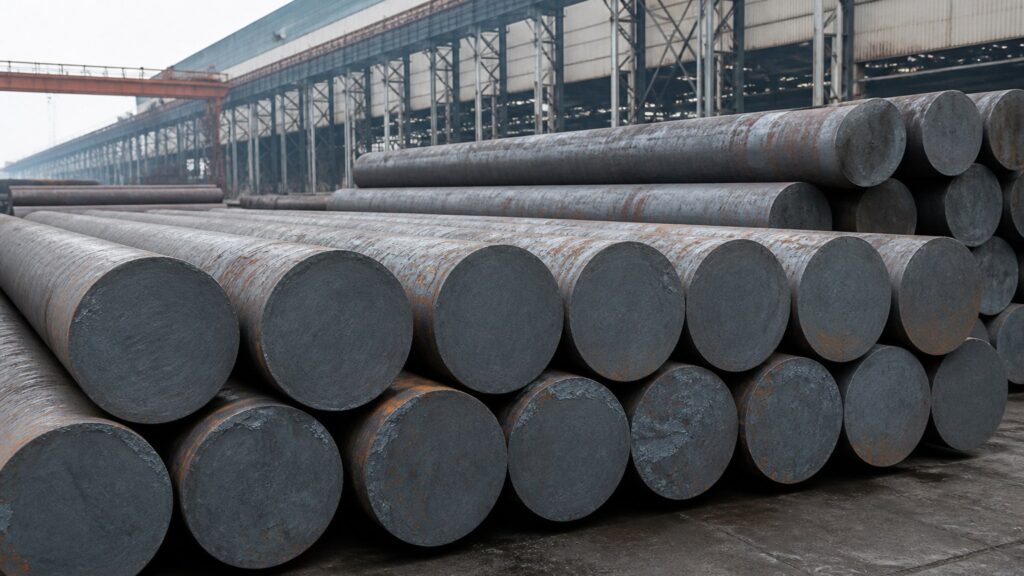
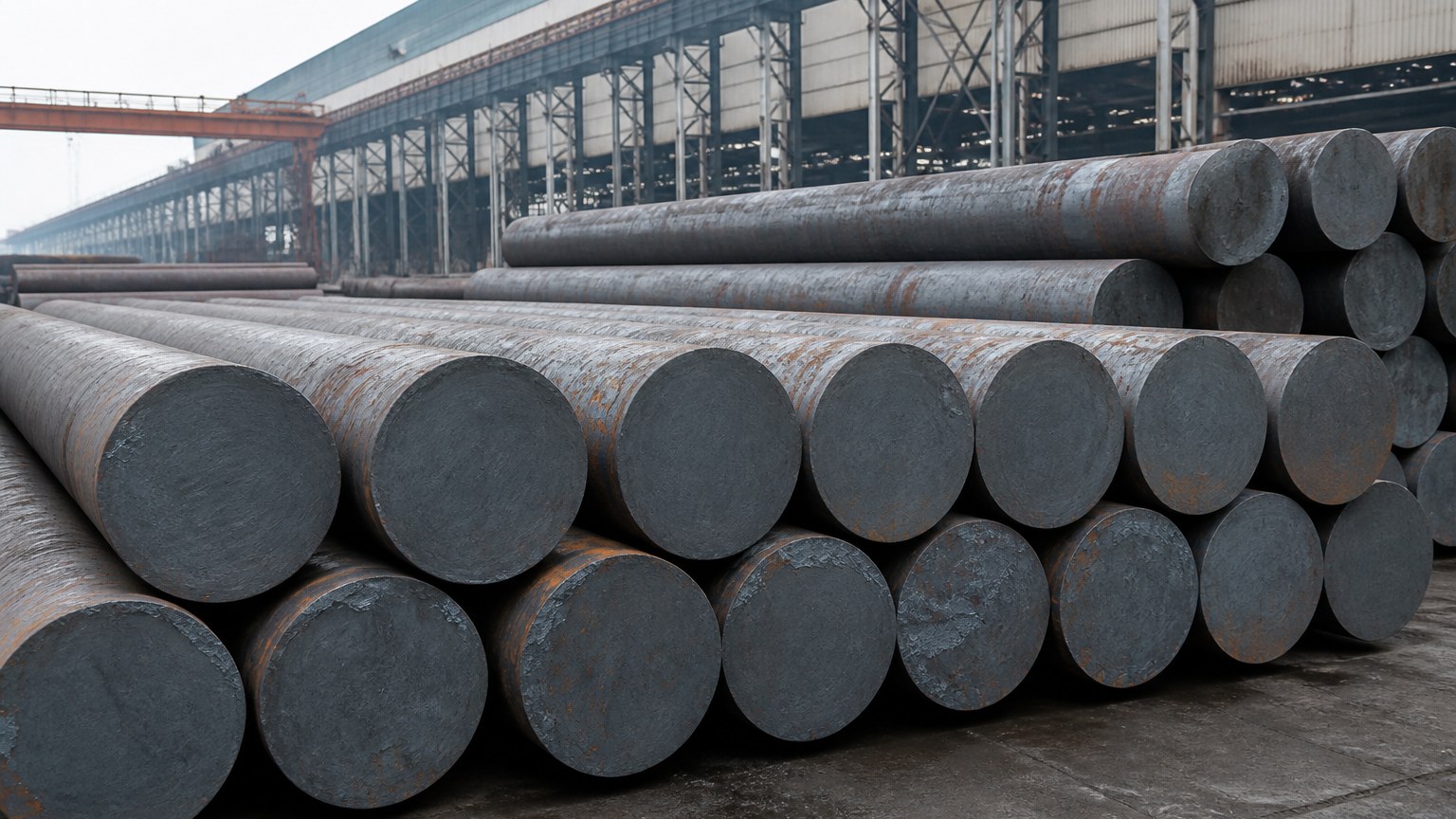
Boiler tube is made from a solid steel billet that is pierced and rolled, not welded from strip. The process route produces the uniform wall boiler service demands.
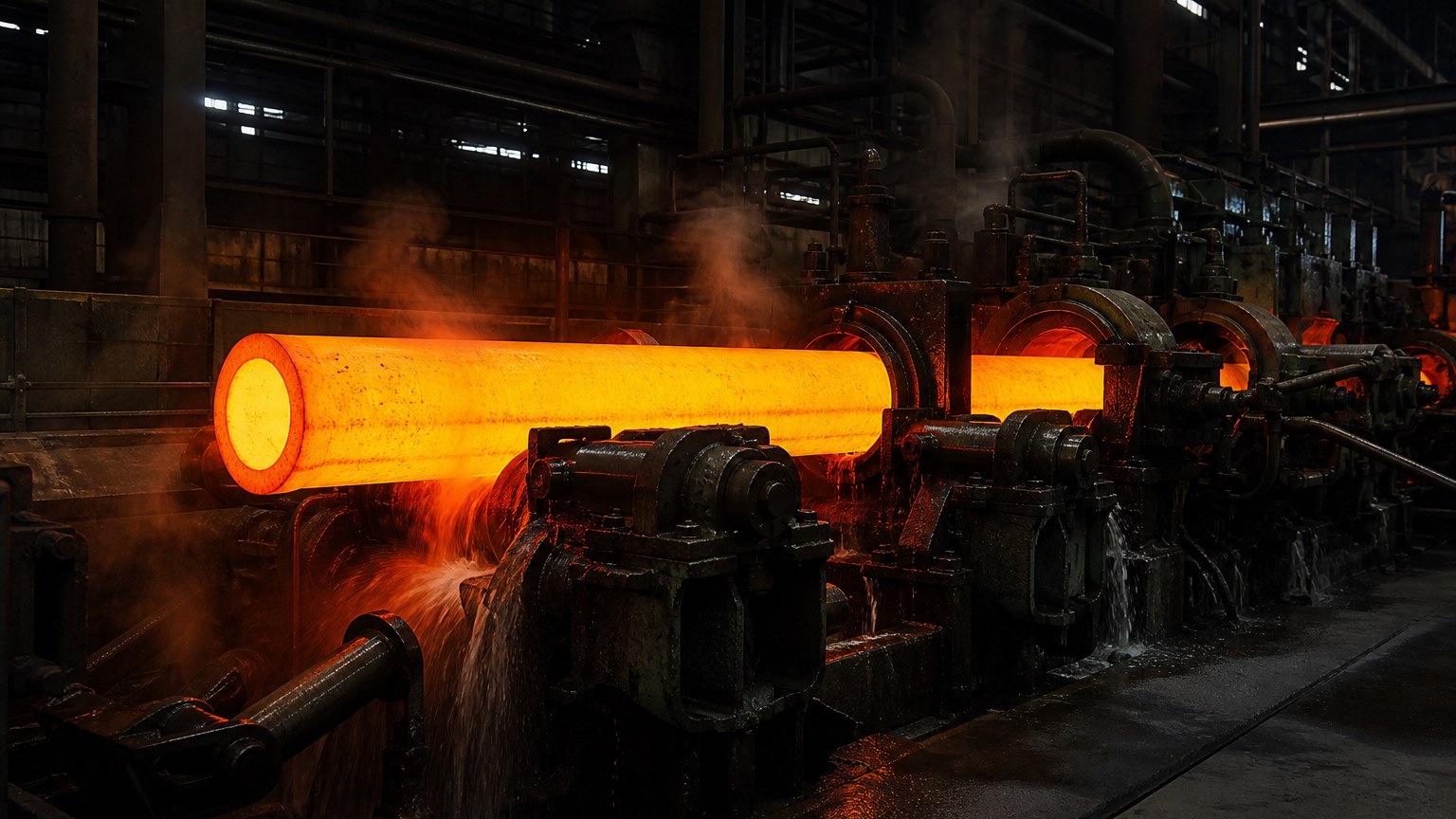
Production starts with a round billet heated to forging temperature, then pierced to create a hollow shell. The shell is rolled, sized, straightened and cut to length, then heat-treated and tested. Cold drawing may follow for tighter tolerances.
Why the pierce-and-roll route suits boiler service
The manufacturing sequence begins with billet heating in a rotary hearth or walking-beam furnace, normally to around 1,200 °C, so the steel becomes plastic enough to deform without cracking. Rotary piercing then passes the billet between barrel-shaped rolls while a fixed plug opens the centre, producing a thick-walled hollow shell. Rolling stages — mandrel mill, plug mill or cross-roll piercer, depending on the mill configuration — stretch the shell and thin the wall toward the target dimension, after which a sizing mill brings the outside diameter within tolerance and the tube is straightened, cut and inspected. For high-pressure boiler tube the mill typically continues into a heat-treatment line, because the rolling operation leaves a microstructure that must be normalised or otherwise treated to deliver the required high-temperature properties. Cold finishing is applied where the order calls for closer wall tolerance, thinner walls or a cleaner surface, and it also improves dimensional consistency along the whole length.
Compare that with welded pipe production, in which coil or strip is formed into a cylinder and joined by a longitudinal or spiral weld. Welding is faster and cheaper, and modern non-destructive testing makes welded product reliable for many services — which is why large-diameter transmission lines are welded. But in a boiler, the absence of a weld seam has three practical advantages. There is no weld metal or heat-affected zone whose high-temperature behaviour must be separately qualified. There is no seam-related defect class — lack of fusion, hook cracks or selective seam corrosion — to inspect for along the full length. And there is no internal weld bead to interfere with flow or with the tight fit-up of tube-to-tube welds in a dense tube bank.
Process control is what makes the difference real rather than theoretical. Wall-thickness eccentricity, surface defects and residual stresses are all created or avoided at specific stages: piercing alignment governs wall uniformity, rolling temperature governs surface quality, and heat treatment governs whether the specified mechanical properties hold along the full length. A buyer who reviews the manufacturing route — and the corresponding test results — is therefore checking the product, not just the paperwork. Understanding how boiler steel pipe is manufactured in detail is the fastest way to judge whether a mill can deliver boiler-grade tube rather than general-purpose pipe.
What Tests and Certificates Prove Boiler Steel Pipe Quality?
A boiler tube’s certificate is not a formality. The specified tests are the only evidence that the wall, the chemistry and the heat treatment meet the standard you ordered against.
Boiler tube standards typically require chemical analysis, tension testing, flattening or flaring testing, hardness testing where applicable, and either a hydrostatic test or a nondestructive electric test of the full length. The mill test certificate records these results with heat traceability.
Reading the test package line by line
Chemical composition comes first, because grade limits on carbon, manganese, phosphorus and sulphur determine both strength and weldability, and the specifications generally restrict elements outside their listed ranges. Tension testing demonstrates that yield and tensile strength and elongation fall within the grade limits. Flattening and flaring tests are ductility checks specific to tubular product: they prove that the tube can be bent into a boiler bend or expanded into a tube sheet without cracking, which is exactly what happens to it on site. Hardness testing sets an upper limit that matters for alloy and higher-carbon boiler grades, since excessive hardness points to a heat-treatment problem. Hydrostatic testing pressurises each tube to prove the body is leak-tight, while a nondestructive electric test examines the full tube volume or weld length for discontinuities. For medium-carbon boiler and superheater tubes, the applicable specification defines the grades and the associated chemical and tensile requirements, and requires both dimensional and mechanical checks on the finished product — a scope worth reading in the standard itself, as the ASTM A210/A210M specification for seamless medium-carbon steel boiler and superheater tubes sets out.
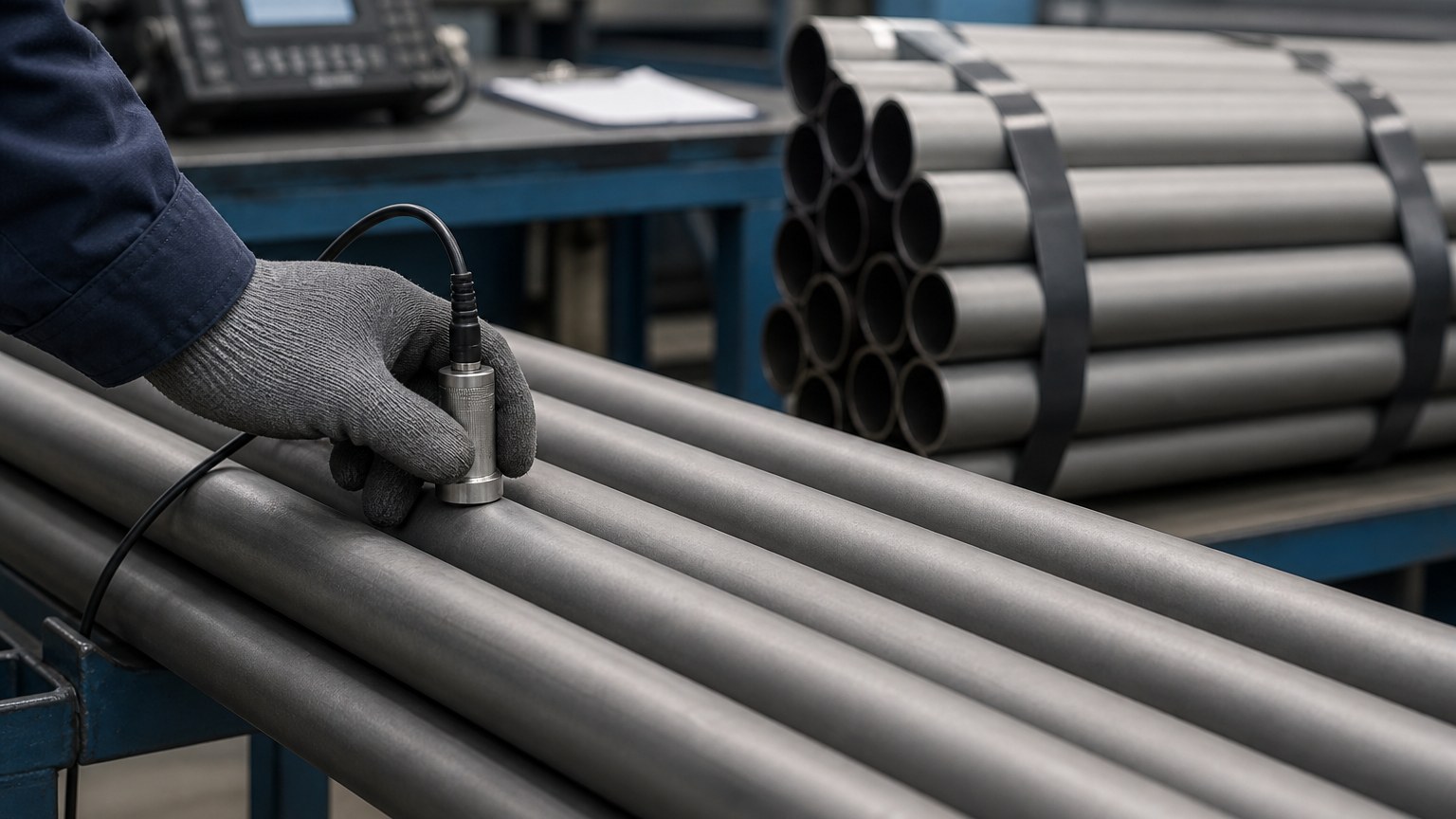
The certificate is where these results become traceable. A mill test certificate should identify the specification and grade, the heat number, the dimensions and quantity, the chemical analysis, the mechanical test results and the testing performed. Three checks catch most problems before shipment. First, confirm the specification number and edition on the certificate match the purchase order exactly — ASTM A106, SA-106, GB 5310 and EN 10216-2 are not substitutes for one another. Second, confirm the manufacturing route is stated as seamless where the order requires it. Third, confirm the test list covers everything the standard requires for that grade and size; where a test is permitted as an alternative, the certificate must show which option was actually performed. For critical orders, third-party inspection that witnesses sampling and reviews hydrostatic records is inexpensive insurance, and it is routine in international boiler tube procurement.
How Do You Specify the Right Boiler Steel Pipe Size, Grade and Schedule?
Most boiler tube problems start at the inquiry stage, not at the mill. An incomplete specification produces offers that cannot be compared, and later disputes about what was ordered.
Fix five things before requesting quotes: the standard and grade; the outside diameter with schedule number; the length and end finish; the required test package; and the quantity. Sizes follow the nominal pipe size and schedule system, where a heavier schedule such as Sch 60 suits higher pressure.
A specification checklist that prevents rework
Start with the design code. It tells you which tube standards are acceptable, what design pressure and temperature must be used, and which examinations are mandatory. Then translate those conditions into a standard and grade. Where the metal temperature is moderate and the fluid is steam or water, a carbon steel boiler or high-temperature pipe grade is normally sufficient; where metal temperatures rise or the atmosphere is corrosive, an alloy or austenitic grade becomes the practical choice. Where the fluid is aggressive on the water side as well, material selection must consider corrosion and stress-corrosion behaviour, not only strength.
Next, fix the dimensions unambiguously. State the outside diameter or nominal pipe size together with the schedule; never quote wall thickness alone, because the same wall can belong to different size systems. Confirm the standard dimensional reference your project uses, and describe steel pipe sizes consistently across the purchase order, the drawing and the inspection plan so that the inspector checks the same figure the designer intended. Add the length, tolerances, end finish — plain or bevelled — and the surface condition required, since some boiler tube standards require the surface condition to be stated in the order.
Then define the test package and documentation. Specify whether hydrostatic or nondestructive electric testing is required, whether additional ultrasonic or eddy-current examination is expected, and what the mill test certificate must contain. Confirm whether third-party inspection is required and at what stage. Finally, state quantity, packing and delivery terms. Tubes for boiler service are commonly supplied with end protection and bundled or boxed to prevent handling damage, because a dented or scratched tube may be rejected on arrival even if its certificate is perfect.
A complete inquiry of this kind allows a mill to quote a comparable product, and it gives you the evidence to verify what arrives. If any of the five items is unclear for your project, speak with our pipe engineers before you issue the inquiry — a fifteen-minute technical review is far cheaper than re-sourcing a rejected heat. For a concrete starting point, our boiler steel pipe 20G 4 inch Sch 60 is supplied in a GB 20G grade under the GB 5310 family, in the 4-inch nominal size with Sch 60 wall — a common combination for high-pressure boiler and steam service. Review the specification table on that page to see how the parameters above are listed, then send your own duty conditions for a mill-direct quotation and certificate review.
Conclusion
Fix standard, grade, size, schedule and test package before comparing offers, then verify every certificate. Boiler steel pipe is chosen by duty, never by price.