
Boiler Tube Grades: How Do 20G, SA-210 and P22 Compare?
A boiler tube ordered in the wrong grade fails at temperature, not at delivery. Grade choice decides creep life, weldability and cost.
Boiler tube grades differ mainly by alloy content, and therefore by the maximum metal temperature they can carry. 20G is a Chinese carbon steel boiler grade, SA-210 Gr.A1 is the ASME medium-carbon equivalent, and P22 (2.25Cr-1Mo) is the low-alloy choice for the hottest superheater service.
The comparison is worth doing properly, because these three grades are not interchangeable versions of the same product. They sit in different standard families, they are qualified against different allowable stresses, and they are welded with different procedures. This guide works through what each grade actually contains, which standard defines it, where its temperature ceiling sits, how the tube and pipe versions of the same chemistry differ, how to choose between them for a real boiler, and what documentation a buyer should expect before the tubes leave the mill.
What Are Boiler Tube Grades and Why Does the Design Temperature Decide Them?
A boiler tube grade is not a marketing tier; it is a qualified material with a certified temperature ceiling that governs where the tube may be installed.
A boiler tube grade defines the steel chemistry, the standard that qualifies it, and the maximum metal temperature it can carry in continuous service. Carbon grades suit the cooler water-wall and economiser sections, while low-alloy chromium-molybdenum grades are reserved for superheater and reheater tubes.
The governing quantity is metal temperature, not steam temperature. The tube wall runs hotter than the steam inside it, and the gap widens as heat flux rises, which is why a furnace water-wall tube absorbs far more heat per unit area than a convection tube deep in the gas pass. Design codes turn that physical reality into an allowable stress: the maximum stress a material may be worked at for a stated metal temperature and design life. Once a proposed service temperature falls outside the published allowable stress table for a carbon steel, the designer has no option but to change material. That is the practical meaning of a grade ceiling, and it is why specifiers treat the ceiling as fixed rather than negotiable, because it comes from the design code rather than from the mill. Steam that has been pushed above its saturation temperature is known as superheated steam, a distinction that explains why the hottest tube banks in a boiler are the ones that force an alloy grade — the background is set out in the general description of a superheater, where radiant, convection and separately fired arrangements are compared. Take the three grades in this article as the illustration. 20G sits in the Chinese boiler tube family and is referred to moderate-temperature boiler heating surfaces. SA-210 Grade A1 is its ASME medium-carbon counterpart, covered by ASTM A210/A210M, with carbon capped near 0.27 percent and manganese near 0.93 percent. Neither grade earns a deliberate chromium or molybdenum addition, and that single omission sets the ceiling: without alloying elements that stabilise the microstructure at temperature, the steel creeps faster and oxidises faster as heat rises. P22 carries roughly 1.90 to 2.60 percent chromium and 0.87 to 1.13 percent molybdenum, which raises creep rupture strength enough to justify the much higher allowable temperatures it is approved for.
Why the ceiling is a code number rather than a mill promise
A mill can roll any chemistry to any specification, but the allowable stress figures published in the design code are the only numbers an inspector or a notified body will accept. When a tube is proposed for service above the published range of its grade, the substitution is a design change. It requires re-qualification of the allowable stress, the welding procedure and, frequently, the tube-to-header attachment detail. The right time to ask that question is at enquiry stage, when the answer is still a material selection decision rather than a fabrication problem. The range of sizes, walls and standards normally held in stock for this product family is summarised under boiler tube grades supplied in seamless form.
What Is 20G Boiler Tube, and Where Does GB/T 5310 Apply?
20G is specified more often than it is understood. Buyers who treat it as a generic carbon tube miss the test and tolerance obligations the boiler standard carries.
20G is a Chinese seamless carbon steel boiler tube grade ordered against GB/T 5310. It contains roughly 0.17 to 0.24 percent carbon, 0.17 to 0.37 percent silicon and 0.35 to 0.65 percent manganese, with a tensile band of about 410 to 550 MPa and a minimum yield near 245 MPa.
Read the designation literally and the meaning is clear. The number 20 identifies the base carbon steel grade, the same family as the 20# pipe used in general piping, and the letter G marks the boiler tube application. That suffix is not cosmetic: it brings tighter limits on sulphur and phosphorus, closer control of wall thickness, mandatory flattening and flaring tests, and a full test document package. Sulphur and phosphorus are each held to roughly 0.030 percent maximum, because both elements segregate at grain boundaries and reduce ductility in a component that will be expanded into a header and cycled for decades. The tensile band of 410 to 550 MPa with a minimum yield near 245 MPa places 20G firmly in the medium-carbon, moderate-temperature class rather than in the creep-resistant class, and the grade’s limitations follow directly from that position. A carbon and manganese balance keeps the steel weldable without preheat in ordinary wall thicknesses, which is a genuine operational advantage in a fabrication shop. The absence of deliberate chromium and molybdenum means there is no meaningful creep rupture allowance at high metal temperature. In practice, 20G is specified for boiler heating surfaces where the tube wall stays within the moderate band: economisers, lower furnace water walls, and convection banks in industrial boilers with a modest steam outlet condition. It is widely rolled in the Chinese market, competitively priced, and well supported by fabricators holding qualified welding procedures for it, which is exactly why it appears in so many export enquiries. Two questions settle whether 20G is the right answer for a project. The first is the edition of the standard cited, because properties and test requirements have been revised between editions. The second is whether the end user’s design code accepts a GB grade alongside the ASME alternatives. Both are answered by the mill certificate and the allowable stress table, never by the grade name. Sizing causes a separate set of errors, because tube and pipe follow different conventions: the relationship between nominal bore, outside diameter and wall is set out in our guide to boiler tube dimensions.
A worked example: the economiser enquiry
An industrial boiler retrofit calls for 20G economiser tubes in a moderate wall thickness. The enquiry should state the standard edition, the outside diameter and wall as minimum or average values, the length and end finish, and the test documents required. A supplier quoting a general carbon tube to a line pipe standard will often price lower, because the test package is smaller and the sulphur and phosphorus limits are looser. The two offers are not comparable until the standard is written on the quotation, which is the single most common source of dispute in this grade.
What Does SA-210 Grade A1 Require That 20G Does Not?
Switching from a GB grade to an ASME grade is not a translation exercise. SA-210 Grade A1 adds manufacturing and hardness obligations that change what the mill must prove.
SA-210 Grade A1 is a seamless medium-carbon boiler and superheater tube grade under ASTM A210/A210M. It requires killed steel and the seamless process, carries a minimum tensile strength of 415 MPa, and is supplied in outside diameters from 0.5 to 5 inches.
The differences that matter commercially are in the fine print rather than the headline. ASTM A210/A210M begins with a mandatory melting practice: material must be killed, which means fully deoxidised steel, typically with aluminium or silicon, so that the ingot or billet is free of the gas porosity that would show up later as internal defects in a pressure boundary. It then restricts the product to the seamless route and requires the tube to be marked as either hot-finished or cold-finished, because the two routes carry different dimensional tolerance and surface condition expectations. Surface condition must be stated in the order rather than assumed, which removes the ambiguity that causes rejections at goods-in. The standard covers two grades, A-1 and C, with different chemical and tensile requirements. Grade A-1 is the lower-carbon of the two, capped near 0.27 percent carbon with manganese near 0.93 percent maximum, and it carries a minimum tensile strength of 415 MPa. Grade C runs to a higher carbon and therefore a higher tensile requirement, and it is chosen when additional strength is needed at the same temperature rather than when a higher temperature is needed. A hardness limit applies to both, although the mechanical property requirements are qualified by size limitations in the standard, so a buyer comparing quotations should check that the quoted tube falls inside the range where the properties are actually specified. The test regime is where the two standard families diverge most visibly. A210 requires a tension test, a flattening test, a flaring test and a hardness test, plus either a hydrostatic test or a non-destructive electric test on each tube, and superheater tubes must further demonstrate that they can be expanded, beaded, forged, welded and bent without defects. A GB/T 5310 order will require an equivalent family of tests, but the acceptance criteria and the witness points are not identical. That is why an order transferred between standards should be re-written rather than re-labelled, with tube sizes specified as minimum wall where the standard intends it, and with the inspection and document requirements spelled out.
Grade A-1 or Grade C: the decision inside one standard
Within A210 the choice is driven by strength rather than temperature. Grade A-1 suits the majority of evaporator and moderate superheater duty where the design stress is comfortably met by a 415 MPa minimum tensile. Grade C buys additional tensile strength through higher carbon, at some cost in weldability, and is selected when a thinner wall is required to achieve the same pressure rating or when an existing drawing already calls for it. Because both grades live in the same specification, the grade letter on the purchase order and on the mill certificate is the only thing separating two very different tubes.
How Does P22 Differ From 20G and SA-210?
P22 is where the comparison changes character. The word grade stops describing a carbon steel variant and starts describing an alloy chosen for creep resistance.
P22 is a 2.25Cr-1Mo low-alloy steel. Its nominal chemistry is roughly 1.90 to 2.60 percent chromium and 0.87 to 1.13 percent molybdenum, with minimum tensile strength of about 415 MPa. It is the standard alloy choice for superheater and reheater tubes.
Two designations describe the same steel, and confusing them is a common procurement error. T22 is the tube designation under ASTM A213/A213M, which covers seamless ferritic and austenitic boiler, superheater and heat exchanger tubes in outside diameters from about 1/8 inch inside diameter up to 5 inches outside diameter. P22 is the pipe designation under ASTM A335/A335M, which covers seamless ferritic alloy steel pipe for high-temperature service and is used for headers, steam lines and other piping items. The chemistry is essentially the same and the allowable stress tables in the design code treat them as the same material; what differs is the product form, the dimensional convention, the heat treatment tolerance and the test schedule. Chromium is the element that changes the behaviour of the steel. At roughly 2.25 percent it forms a protective oxide scale that resists high-temperature oxidation and gives the material its corrosion resistance in steam and flue gas. Molybdenum raises the creep rupture strength by hindering the movement of dislocations at temperature, which is exactly the property that allows a designer to publish an allowable stress for P22 well beyond the ceiling of any carbon steel. Service temperatures in the region of 590 degrees Celsius are commonly cited for T22 in superheater and reheater duty, a figure that no 20G or A-1 tube could be approved for. The trade-off is fabrication. A 2.25Cr-1Mo steel needs controlled preheat, a qualified procedure, low-hydrogen consumables and post-weld heat treatment, because the alloy hardens in the heat-affected zone and forms a brittle martensitic structure if it cools too quickly. Field repairs that would be routine on a carbon tube become engineering tasks on P22, and the welding procedure qualification is a real line item in a project budget. For a power plant, that cost is accepted because the alternative at high temperature is not a cheaper tube but a shorter tube life.
Why the same chemistry is sold under two designations
The design code determines allowable stress from chemistry, product form and heat treatment together, so the standard number on the certificate must match the item being supplied. A header fabricated from A335 P22 pipe and superheater elements made from A213 T22 tube are dimensionally and metallurgically compatible, and welding them together is a standard joint detail in boiler construction. The mistake to avoid is ordering one and expecting the test documents of the other, because the hydrostatic, non-destructive examination and hardness requirements are written per standard.
How Do You Choose Between 20G, SA-210 and P22 for a Project?
Choosing a boiler tube grade is a sequence, not a preference. Start with the design metal temperature and the answer is usually decided before price is considered.
Select the grade from the design metal temperature and the allowable stress table, then confirm the product form, the code acceptance and the availability. 20G and SA-210 Grade A1 cover the moderate-temperature heating surfaces; P22 is required where superheater or reheater metal temperature exceeds what a carbon steel can sustain.
The first question is always temperature, and it should be answered with the metal temperature at the tube wall rather than the outlet steam temperature, because the wall runs hotter and the margin between them is not constant along the gas path. From that figure the allowable stress table gives the grade, and the pressure calculation converts the allowable stress into a wall thickness. Everything after that is a series of confirmations. Confirm the product form, because a header needs pipe and a heating surface needs tube, and the standards are not interchangeable even when the chemistry is. Confirm the dimensional convention, because the tube sizes most commonly furnished to a tube specification are quoted as outside diameter and minimum wall, while pipe sizes follow the schedule system in ASME B36.10M, and mixing the two is how a tube arrives with the wrong wall. Confirm code acceptance early when a GB grade and an ASME grade are being compared, because the end user’s design code, not the mill, decides which allowable stress may be used. Then confirm availability and welding capability, since a technically superior alloy that no qualified welder can join within the schedule is a project risk rather than a benefit.
| Item | 20G | SA-210 Grade A1 | P22 / T22 |
|---|---|---|---|
| Governing standard | GB/T 5310 | ASTM A210/A210M | ASTM A335 (pipe) / A213 (tube) |
| Chemistry type | Medium carbon steel | Medium carbon steel, killed | 2.25Cr-1Mo low alloy |
| Carbon, % | About 0.17 to 0.24 | About 0.27 max | About 0.05 to 0.15 |
| Chromium, % | Not deliberate | Not deliberate | About 1.90 to 2.60 |
| Molybdenum, % | Not deliberate | Not deliberate | About 0.87 to 1.13 |
| Minimum tensile, MPa | About 410 to 550 band | 415 | About 415 |
| Typical duty | Economiser, lower water wall | Evaporator, moderate superheater | Superheater, reheater, hot steam piping |
| Welding | No preheat in normal walls | No preheat in normal walls | Preheat and post-weld heat treatment |
The table is a screening tool, not a substitute for project design. Its useful function is to make the trade explicit: the two carbon grades buy low cost, easy welding and fast availability, while P22 buys temperature capability at the price of a controlled welding regime. Once the temperature question has been answered honestly, the rest of the decision is about matching the product form to the item being fabricated. A ready reference for the wall thicknesses that sit behind these grade choices is our how schedule numbers map to real wall thickness summary, which lists the standard walls from Sch 10 to Sch 160 for the sizes buyers order most often. Where a specification already calls for SA-210 Gr.A1 in a 2 inch outside diameter, the supplied dimensions and test documents are listed on the product page for SA-210 Gr.A1 boiler tube in 2 inch.
How Are Boiler Tube Grades Verified Before Shipment?
Verification is where grade selection either holds or collapses. A certificate that does not match the order is a stop-work signal, not paperwork.
Boiler tube grades are verified by reconciling the mill certificate against the purchase order, then confirming chemistry, tensile properties, hardness, dimensions and non-destructive examination results on the actual tubes before dispatch.
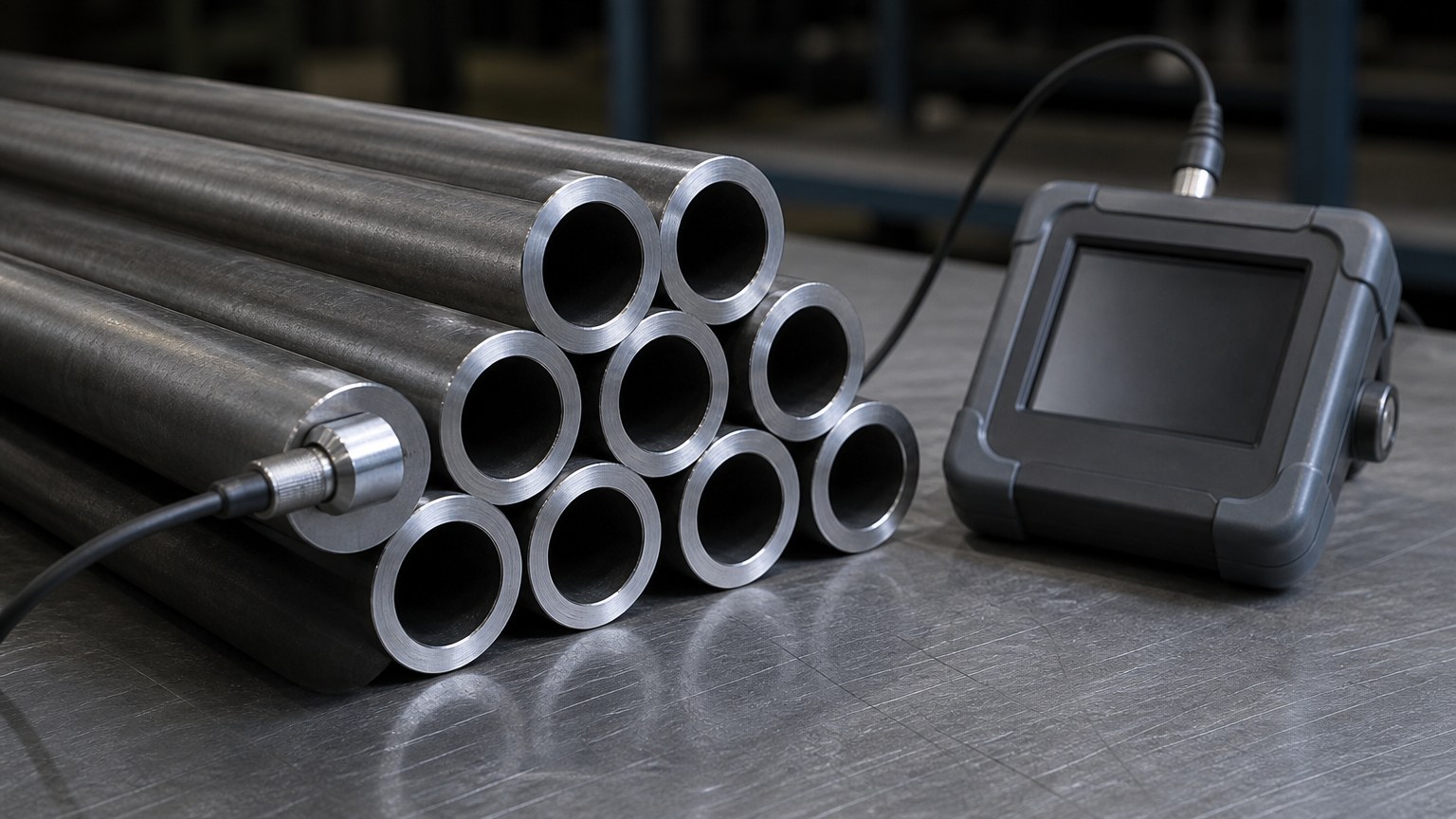
The verification sequence follows the material through the mill rather than the drawing. Chemistry comes first, because no later test can compensate for the wrong heat. A spectrochemical analysis of the finished tube, or a positive material identification check on a sample, confirms that the chromium and molybdenum in a P22 heat are actually present and that a carbon grade has not been substituted; on an alloy order this single test prevents the most expensive category of failure. Mechanical testing follows. The tension test establishes tensile strength, yield strength and elongation against the grade minimums, and the flattening, flaring and hardness tests check the ductility that allows a tube to be expanded into a header and bent into a serpentine without cracking. Hardness deserves particular attention on alloy tubes, because a hard heat-affected zone left by a poor heat treatment or a field weld is where cracking begins in service, and the published hardness limits exist for that reason. Dimensional inspection covers outside diameter, wall thickness and length, with wall measured on an ultrasonic gauge at several positions around the circumference and the minimum value recorded rather than the average. Non-destructive examination is required by the tube standards and is normally performed as a hydrostatic test or an eddy current test on each tube, and where the application is critical the buyer should specify which. Marking and documentation close the loop: the heat number, grade, standard and size must be legible on each tube or bundle, and the certificate must trace the delivered material back to the test results for that heat. A 3.1 certificate issued by an independent inspection body is the normal requirement for export power projects, and it should be agreed at order stage rather than requested after production. If you want these verification steps, tolerances and document requirements written onto a quotation in advance, send us your tube specification for a quotation with the grade, size, quantity and governing standard.
The documents to request with every boiler tube order
- Mill test certificate with heat number, chemistry and mechanical results, issued to the standard cited on the order.
- Hydrostatic or eddy current test report, identifying the method applied and the tubes covered.
- Dimensional record for outside diameter, minimum wall and length, including the measurement method.
- Hardness results where the grade or the order carries a hardness limit.
- Heat treatment record for alloy tubes, showing the condition supplied.
- Packing list and marking schedule matching the tube markings to the certificate.
Conclusion: 20G and SA-210 Gr.A1 serve moderate-temperature boiler surfaces as weldable carbon grades, while P22 buys high-temperature creep resistance at the cost of controlled welding and tighter inspection.