
Steel Pipe Sizes: What Does Nominal Pipe Size (NPS) Really Mean?
Ordering “a 2-inch pipe” and receiving something that measures 2.375 inches is the fastest way to fail an inspection. The size system is nominal, not literal.
Steel pipe sizes are designated by NPS (Nominal Pipe Size), a dimensionless number that fixes the outside diameter but never equals it: an NPS 2 pipe is 2.375 inches outside. The schedule then sets the wall thickness, which defines the inside diameter and the pressure rating.
Read the five sections below as one specification workflow: what the numbers mean, how the schedule changes the geometry, how to read a dimension table and convert NPS to DN, where carbon and stainless pipe diverge, and how to order the right size the first time. Get the first step wrong and every quotation that follows is describing a different product.
Why Is Nominal Pipe Size (NPS) Not an Actual Diameter?
The word nominal is a warning label. NPS identifies a pipe family; it does not describe any dimension you can measure with a tape.
NPS is a non-dimensional size designation that groups pipe with a fixed outside diameter. For NPS 1/8 to NPS 12 the number differs from the real OD — NPS 12 measures 12.75 inches — while from NPS 14 upward the two coincide, so NPS 14 is 14.00 inches OD.
NPS grew out of the iron pipe size (IPS) system, and the mismatch between the number and the measurement is a fossil of that history. When the original tables were written, the number was chosen so that a pipe of that nominal size had roughly the inside diameter implied by its name, using the wall thicknesses that were standard at the time. As thinner and heavier walls were added in 1927 and afterwards, the inside diameter moved but the number stayed. Today NPS is simply an identifier, and the outside diameter is what anchors every other dimension in the system. That matters commercially because the outside diameter is the dimension that governs joining: a fitting, flange, coupling or weld prep is made to the OD, so an NPS 6 pipe from any mill, in any schedule, in any grade, will bolt up to an NPS 6 flange. This is the practical value of the nominal system, and it is the reason the standard has survived a century of revisions — interchangeability of connections across wall thicknesses and materials. What is not interchangeable is the bore, and that is where most specification errors begin. A buyer who reads “6-inch” as a flow dimension and a buyer who reads it as a connection dimension are both correct in their own context and will disagree at inspection unless the schedule is stated on the purchase order. The same logic explains why the nominal number survives in drawings even though every engineer knows it is not a measurement: it names the joint, not the hole.
Where the mismatch comes from
For NPS 1/8 through NPS 12, the nominal number is smaller than the actual outside diameter — NPS 1/2 is 0.840 inch, NPS 2 is 2.375 inches, NPS 6 is 6.625 inches. From NPS 14 upward the outside diameter equals the number exactly. Steel pipe sizes therefore fall into two behavioural zones, and a dimension table that does not state which zone you are reading is not usable for procurement.
What to write on an inquiry
Write both identifiers, never one alone: NPS plus schedule, followed by grade, standard and end finish. The reference tables published for the Nominal Pipe Size system are useful when checking a quotation, and the OD column should be present on every mill certificate. If you also need the finished pipe, the steel pipe sizes we can supply cover the common NPS and schedule combinations in seamless and welded form.
How Does the Schedule System Change the Size of a Steel Pipe?
The schedule is the second half of a steel pipe size. It fixes the wall, and the wall is what decides whether the pipe is pressure-capable or decorative.
For a given NPS the outside diameter is fixed and the schedule sets the wall thickness, so a higher schedule number means a thicker wall and a smaller bore. Since 1939 the pressure rating of a pipe has been tied to this single number.
The schedule number is not a thickness and not a millimetre figure; it is a shorthand. It was derived from the ratio of design pressure to allowable stress for a given size, which is why the same schedule number produces very different walls on a 2-inch pipe and a 24-inch pipe. An NPS 2 Sch 80 wall is 0.218 inch, while an NPS 24 Sch 80 wall is 1.218 inches — nearly six times thicker. Reading a schedule as though it described a fixed physical wall is the second most common error in pipe buying, after treating NPS as an actual diameter. The commercial consequence is that a schedule change is a weight change, and weight is what you pay for. Moving from Sch 40 to Sch 80 on an NPS 6 pipe raises the wall from 0.280 inch to 0.432 inch and adds roughly half as much steel again per metre. Freight, lifting, support spacing and welding consumables all scale with that weight. Conversely, a thin S-series stainless wall can reduce weight and cost substantially, but it also removes the ability to thread the pipe and reduces pressure capacity, so it is a design decision rather than an optimisation exercise. The rule that follows from all of this is that the schedule belongs to the drawing, not to the buyer’s convenience: once the piping code has produced a required wall, the schedule on the order is the design output, and rounding it down to save tonnage is a compliance risk rather than a commercial win.
Which schedules are actually stocked
Sch 40 (identical to standard weight up to NPS 10) and Sch 80 (identical to extra strong up to NPS 8) dominate global inventories, which is why they are the cheapest and fastest to buy. Schedules 10, 20, 30, 60, 100, 120 and 160 are order-specific in most markets, so getting the wall right is as much about lead time as about price — you can see how schedule numbers change wall thickness across the full range before you commit. The dimension series itself is published in ASME B36.10M for wrought steel pipe, with a parallel series in B36.19M for stainless steel pipe.
What Do the Numbers in a Steel Pipe Size Table Tell You, and How Do You Convert NPS to DN?
A dimension table is only useful if you know which column is fixed and which one moves. Two of the four columns are constant for a nominal size.
For a given NPS the outside diameter is fixed and the wall thickness varies with schedule, so the inside diameter falls as the schedule rises. DN is the metric equivalent name for the same size, not a millimetre measurement: DN 150 is NPS 6.
Read the table in a fixed order and errors disappear. Start with NPS, because it sets the OD and the connection. Move to schedule, because it sets the wall. Calculate or read the inside diameter, because that is the dimension the flow calculation uses. Finally check the wall in millimetres against the drawing, because international drawings are frequently dimensioned in millimetres and a rounding mistake of one millimetre is a different schedule in the smaller sizes. The inside diameter is the number buyers most often overlook. An NPS 6 pipe in Sch 40 has a 6.065-inch bore, in Sch 80 a 5.761-inch bore, and in Sch 160 only 5.187 inches. For a given volumetric flow rate the velocity therefore rises with the schedule, and pressure drop rises with velocity, so a line sized on the thin wall and then delivered heavy can miss its hydraulic duty even though the OD, the flange drilling and the length are all exactly as specified. Weight per metre is the third quantity that follows directly from the table, and it is the one that turns into money: for carbon steel pipe the working formula multiplies OD minus wall by wall, so a small wall change moves the tonnage materially. Because the outside diameter is fixed by NPS and only the wall moves, dimensional tolerances are written against both, and carbon steel pipe ordered to ASTM A53 is inspected against those tolerances — which is why a caliper reading at the pipe end is the fastest field check a buyer can perform.
How do you convert NPS to DN and millimetres?
DN is a dimensionless nominal diameter defined for pipework components and paired one-to-one with NPS: DN 15 is NPS 1/2, DN 50 is NPS 2, DN 150 is NPS 6, DN 300 is NPS 12. DN is not the outside diameter in millimetres and not the bore. The conversion is a name change, not a calculation, and that is exactly why it goes wrong. DN 100 does not mean 100 mm of anything on an NPS 4 pipe, which measures 114.3 mm outside and 102.26 mm inside in Sch 40. A drawing that treats DN 100 as a 100 mm bore will produce flanges and supports sized to the wrong dimension, and a spare-parts enquiry written as “100 mm pipe” without a schedule or a standard will be answered with a product the buyer did not intend. Inch and metric wall thicknesses cross awkwardly too: the B36.10M series is defined in inches and converted to millimetres with rounding applied, so 0.375 inch becomes 9.53 mm and 0.500 inch becomes 12.70 mm. Where a project specifies metric wall thicknesses directly rather than converted inch values, the two may not coincide, and the buyer has to decide which standard governs.
NPS to DN quick reference
NPS 1/2 → DN 15 · NPS 3/4 → DN 20 · NPS 1 → DN 25 · NPS 1-1/4 → DN 32 · NPS 1-1/2 → DN 40 · NPS 2 → DN 50 · NPS 3 → DN 80 · NPS 4 → DN 100 · NPS 6 → DN 150 · NPS 8 → DN 200 · NPS 10 → DN 250 · NPS 12 → DN 300. For sizes above NPS 12 the outside diameter equals the number in inches, so DN 350 corresponds to NPS 14 and its OD is 355.6 mm rather than 350 mm. Where a project mixes imported and domestically produced pipe, the conversion convention belongs in the purchase specification, not in a supplier’s interpretation.
How Do Steel Pipe Sizes Differ Between Carbon Steel and Stainless Steel?
The outside diameters are shared; the wall series are not. Mixing the two tables in one procurement document is a classic source of dimensional rejection.
Carbon steel pipe follows ASME B36.10M with schedules 10 to 160 and XXS. Stainless steel pipe follows ASME B36.19M with the S-series (5S, 10S, 40S, 80S). Up to NPS 8 the 40S and 80S walls equal Sch 40 and Sch 80; above that the S-series is thinner.
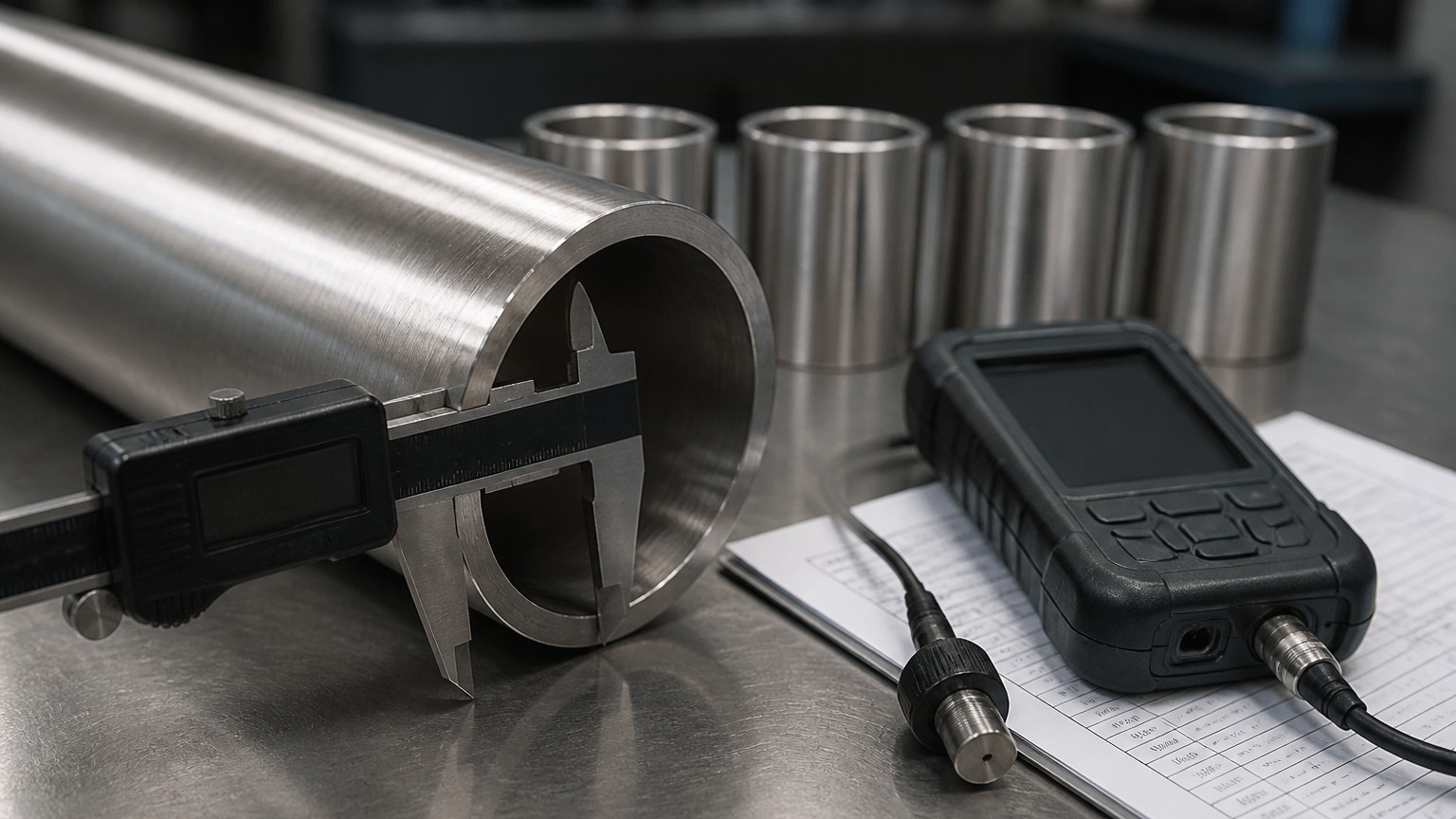
The reason for a separate stainless series is cost. Stainless pipe is frequently specified for corrosion resistance rather than for pressure, and every millimetre of wall is expensive in 304 or 316. The S-series keeps the outside diameter — and therefore every fitting, flange and weld preparation — unchanged while trimming the wall to the minimum that satisfies the design. In process plants this is normal practice: a stainless line may be Sch 10S where the same duty in carbon steel would be Sch 40, because the corrosion allowance that carbon steel needs is simply not required. The trap is that the S-series designations look interchangeable with the plain series and are not. Sch 10 and Sch 10S are identical only up to NPS 8 and diverge above it. A buyer who specifies “Sch 10” without stating the material can receive a heavier carbon pipe or a lighter stainless pipe depending on which table the mill applies, and in a mixed carbon-and-stainless purchase order the mistake can pass unnoticed until the two lines are welded together with a mismatched wall at the joint. Material also changes how sizes are verified, because stainless pipe is commonly ordered to austenitic grades such as 304/304L and 316/316L, produced to ASTM A312 in the S-series or heavier walls, and those grades cost far more than carbon steel — so grade verification matters as much as dimension verification. Positive material identification on a sample from each bundle confirms the alloy, and the wall is checked with a caliper or ultrasonic gauge at both ends.
Stainless versus carbon: the shortcut
Same outside diameter, different wall series. Say “Sch 40S” or “Sch 10S” when you mean stainless, and “Sch 40” or “Sch 10” when you mean carbon steel. One letter prevents most dimensional disputes. A practical example of a lighter-wall stainless product is the 316 stainless steel pipe in 2 inch Sch 10, supplied seamless with a 0.109-inch wall and a 2.375-inch outside diameter; if the wall matters to your process rather than only the size, it is worth understanding how seamless pipe is actually manufactured, because the production route constrains the wall-to-diameter combinations a mill can deliver without a special order.
Which Steel Pipe Sizes Should You Stock or Order?
Stocking decisions follow availability, and availability follows the schedules and sizes the global market actually rolls in volume.
Limit stock to NPS 1/2 through NPS 12 in Sch 40 and Sch 80, in the grades your customers repeat, because those combinations carry the shortest lead times and the most competitive pricing. Order other schedules and larger diameters against a project.
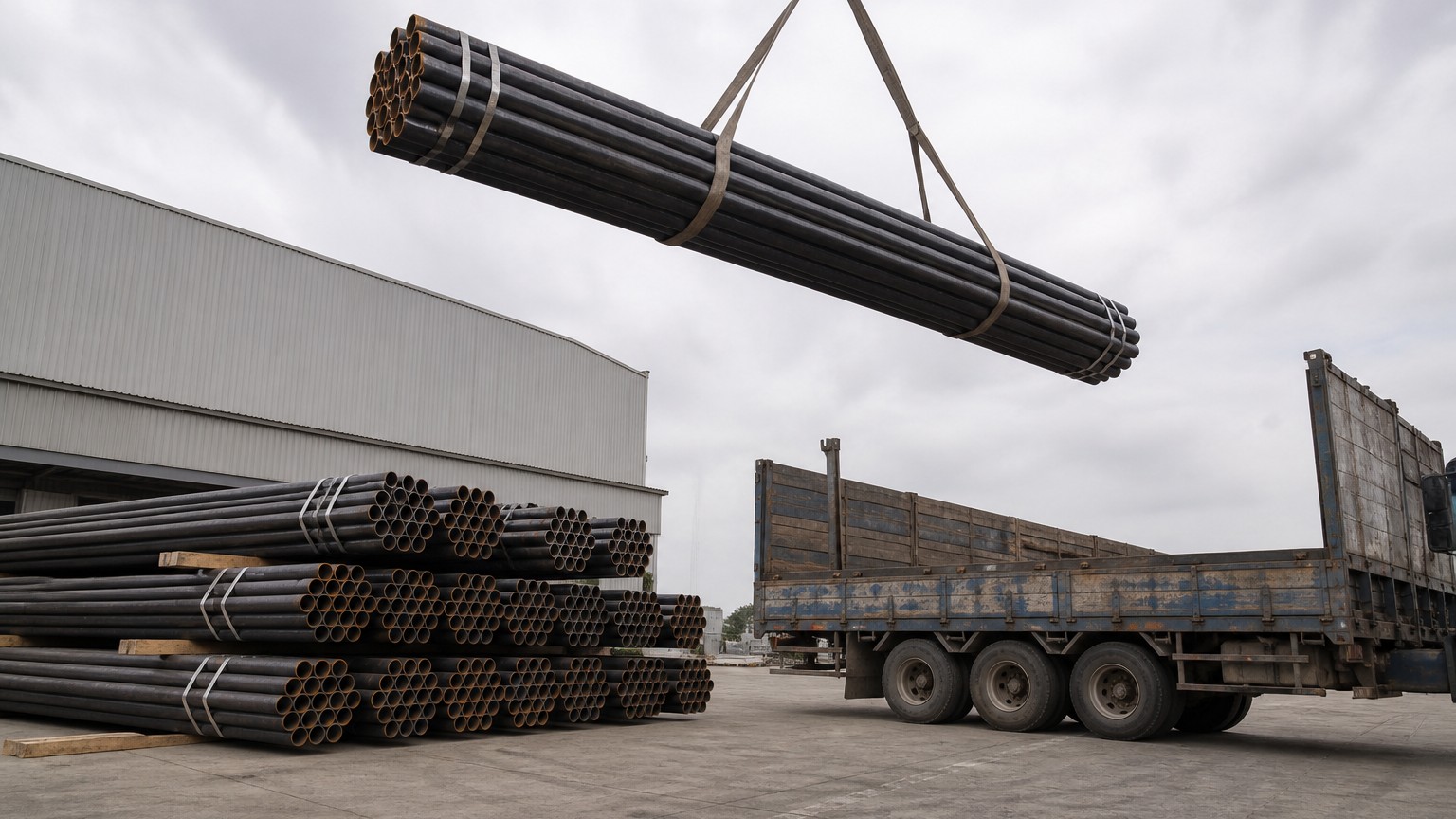
The economics are straightforward. Sch 40 and Sch 80 in the common small and medium sizes are produced continuously by mills in every region, so they are a commodity with transparent pricing and fast delivery. A thin S-series stainless wall in a large diameter, or an XXS carbon wall, may be produced only on a campaign basis: the mill schedules the rolling, the minimum order quantity rises, and the lead time can extend from weeks to months. A stocked profile that ignores this reality ties up working capital in sizes nobody orders while missing the fast-moving items. Grade choice compounds the effect. Carbon steel pipe for general service is widely available in standard structural and pressure grades, while line pipe for oil and gas is ordered to the API 5L family in grades such as X42 through X70 and in two product specification levels, PSL1 and PSL2, with different testing, marking and traceability packages. Those are ordered to a pipeline project, with a specific diameter, wall and coating, not held as general stock. Because the standard’s requirements differ between the two levels, ordering line pipe sizes correctly means stating the grade, the PSL, the diameter, the wall and the end finish together. Buying on diameter alone is the third recurring error in pipe procurement, after confusing NPS with a measurement and treating a schedule as a fixed wall.
A specification checklist before you send an inquiry
- NPS and DN, stated together so that no conversion is assumed.
- Schedule number, with the S suffix where stainless is intended.
- Outside diameter, wall thickness and inside diameter in the unit your drawing uses.
- Material grade with the standard designation, for example ASTM A53 Grade B, ASTM A312 TP316L or API 5L X52 PSL1.
- Length, end finish (plain end, bevelled, threaded or coupled) and coating if any.
- Quantity by metre or by weight, and the test documents required.
Line pipe adds one more layer, because the API Specification 5L family defines two product specification levels with materially different inspection and marking requirements, and the level must be stated on the order rather than inferred. Once the size, schedule and standard are fixed, comparing suppliers becomes meaningful instead of approximate. Send your size list with the pressure and temperature conditions and the required quantity, and we will confirm availability, weight per metre and the test documents that ship with the order — you can send us your size list for a quotation at any time.
Conclusion
Steel pipe sizes depend on two numbers: NPS fixes the outside diameter, the schedule fixes the wall. State both with the material standard and your pipe will match the design.