
Power Plant Piping: What Do Superheater and Reheater Tubes Require?
Specify the wrong tube for a superheater and it fails in service, not at the mill gate. Creep, oxidation and thermal cycling decide the answer before price does.
Short answer: Superheater and reheater tubes in power plant piping must survive steam-side oxidation, creep and thermal fatigue, so they are ordered to ASTM A213 in alloy grades such as T22 and T91, with verified chemistry, wall thickness and a full test package.
That answer is only useful once you know why each requirement exists. The two tube banks look almost identical on a general arrangement drawing and behave nothing alike in service, because one carries the hottest steam in the cycle and the other carries steam that has already given up most of its energy to the high-pressure turbine. This guide works through what each bank actually has to withstand, which standards and grades are used to specify them, how creep and thermal cycling set the service life, and what belongs on a purchase order before the tubes are rolled.
What Makes Power Plant Piping Different From Ordinary Process Piping?
A power plant pipe is not judged on pressure alone. It is judged on what happens to the metal after 100,000 hours at temperature.
Power plant piping carries steam at high pressure and high temperature, so design is governed by allowable stress at metal temperature, thermal expansion and creep life rather than by pressure alone.
Start with the duty, because one plant contains several piping systems that fail for completely different reasons. A boiler feedwater line runs cold, so its wall is sized by internal pressure and water hammer. A main steam line runs hot but at a roughly steady temperature, so it is designed around creep strength and thermal expansion. A superheater tube bank is different again: it runs hotter than both, and it is the only one of the three that is attacked from two sides at once, by oxidising flue gas on the outside and high-pressure steam on the inside. That double exposure is why the hottest tube bank, not the thickest pipe, is usually the part of the steam circuit that limits plant life. The second difference is the duty cycle. Most power stations in the world are no longer operated as baseload assets; the growth of renewable generation has pushed coal and gas units into daily start-stop and load-following service, and every one of those cycles imposes a strain range on the hottest metal in the boiler. Creep and fatigue then stop behaving as separate problems: a defect that would take decades to grow under steady load can propagate in a few years under cyclic load, which is why modern design codes require a fatigue assessment alongside the allowable stress calculation, and why operators track metal temperature and cycle count as carefully as they track pressure. The third difference is documentation. In ordinary process piping a mill certificate and a dimensional check often close the file, whereas power plant work normally demands a heat-specific certificate, verified chemistry, wall thickness records, non-destructive examination results and a paper trail that ties every delivered tube back to the heat that was tested. That is why the standard number on the purchase order matters as much as the grade letter, and why the size range supplied for power plant piping is normally quoted against a named tube specification rather than a generic product description. The physical arrangement matters too: the three common superheater types — radiant, convection and separately fired — sit in different parts of the gas path and therefore see very different heat flux profiles.
Why metal temperature, not steam temperature, decides the design
The tube wall always runs hotter than the steam inside it, and the gap widens as heat flux rises. A furnace-adjacent radiant tube absorbs far more heat per unit area than a convection tube deep in the gas pass, even when both carry steam at the same pressure. Designers therefore work from metal temperature when they read an allowable stress table, and that single convention explains most disagreements between a buyer reading a datasheet and an engineer reading a code book.
What Do Superheater Tubes Have to Withstand?
A superheater tube is only as good as its oxide scale. The metal must grow a protective layer faster than the steam can attack it.
Superheater tubes carry the hottest steam in the cycle, so they must resist steam-side oxidation and creep at metal temperatures that commonly reach 540 to 620 degrees Celsius, with wall thickness calculated from allowable stress at that temperature.
Three loads act on a superheater tube at the same time, and they are usually treated in the wrong order in procurement discussions. The first is internal pressure, which produces hoop stress and therefore sets the minimum wall. The second is metal temperature, which fixes which grades are even eligible, because above a certain temperature no carbon steel carries a usable allowable stress. The third is the flue gas environment, which decides whether the outer surface survives, and which is normally managed through grade selection and sootblowing practice rather than through wall thickness. Steam-side oxidation is the mechanism buyers underestimate most often. At high temperature, steam reacts with iron to form an oxide layer on the inside surface, and the tube loses wall from the inside out, so the wall you ordered is not the wall you have after several years of service. Alloying elements that form a more protective, slower-growing oxide are what buy the extra life, which is exactly why a 2.25Cr-1Mo or 9Cr-1Mo grade is selected for the hottest superheater stages instead of a carbon steel that merely satisfies the pressure calculation. The practical consequence for a buyer is that wall thickness must be ordered with a corrosion allowance, not simply sized to the pressure equation. The second industrial reality is support and alignment. A superheater bank hangs from headers on hangers and spacers that must let the tubes grow thermally without dragging against each other or against the casing, because tubes that rub will wear through at the contact point long before creep exhaustion, and the failure will look like a material defect to anyone reading the incident report without seeing the support design. The third is weldability: a tube that cannot be joined and heat treated with the procedures available on site is a project risk, however good its high-temperature properties look on paper. Low-alloy and martensitic grades need controlled preheat, low-hydrogen consumables and post-weld heat treatment, and that work has to be planned into the erection schedule rather than discovered during commissioning. When the duty is moderate rather than extreme, the comparison of how high-pressure boiler pipe is specified for power stations shows how much specification effort the duty actually justifies.
How Do Reheater Tubes Differ From Superheater Tubes?
Reheaters look like superheaters and are not. Lower pressure, higher steam flow and a hotter gas path change the failure mode.
Reheater tubes return steam from the high-pressure turbine to the boiler at lower pressure but similar temperature, so they need the same oxidation resistance with less hoop stress and more attention to flow distribution and support.
The reheat cycle exists for one reason: expanding steam all the way from the superheater outlet down to condenser pressure would leave the last turbine stages running in wet steam, and water droplets erode turbine blades. Reheating the steam part-way through the expansion keeps the exhaust dry and raises cycle efficiency, and it happens in a separate bank of tubes that returns steam from the high-pressure turbine to an intermediate pressure and temperature. Two differences follow immediately. Because the returning steam is at a lower pressure, the hoop stress for a given wall is lower than in the superheater, so the reheater is usually thinner-walled for the same external environment; and because the steam has already done work, its mass flow per unit of heat absorbed is higher, and the steam-side heat transfer coefficient is generally better, which sounds helpful until you realise it also means the reheater responds faster to changes in firing rate. Reheater tubes are notoriously sensitive to flow imbalance between parallel paths: a tube receiving less steam than its neighbours runs hotter, oxidises faster and eventually fails, which is why inlet orifices, careful header design and flow modelling matter more here than in most other parts of the boiler. The gas-side environment is also harsher in many designs, because the reheater is frequently located in a hotter part of the convective pass than the primary superheater, and in some boilers it is exposed to radiant heat as well. Materials selection therefore tracks the local heat flux and the flue gas temperature rather than the bank as a whole, and it is common to see two or three different grades within one reheater, with the highest alloy in the final, hottest stages. The service consequence is that reheater replacements are frequently driven by oxidation rather than by creep rupture, because wall loss from the steam side and fireside corrosion both reduce the load-bearing section, and the first sign is usually a rising metal temperature signal at a thermocouple close to the affected tube. A table comparing the two banks makes the trade-offs explicit.
| Requirement | Superheater tubes | Reheater tubes |
|---|---|---|
| Steam source | Saturated steam from the drum | Partially expanded steam from the HP turbine |
| Internal pressure | Highest in the steam circuit | Lower, typically a fraction of main steam pressure |
| Steam temperature | Final steam temperature, controlled by attemperation | Reheat outlet temperature, controlled by dampers or tilting burners |
| Dominant metal temperature driver | Heat flux plus steam temperature | Gas path position and steam flow distribution |
| Wall thickness driver | Hoop stress and oxidation allowance | Oxidation allowance more than hoop stress |
| Typical failure mode | Creep rupture and steam-side oxide growth | Oxidation, flow imbalance hot spots and fireside wastage |
| Grade selection | Carbon steel for cooler stages, Cr-Mo alloys for the hottest | Alloy grades concentrated in the hottest stages |
| Support sensitivity | High, because spans are long and hot | High, because misalignment shows up as tube-to-tube contact |
The useful reading of that table is that the reheater is not simply a colder superheater. It is a bank whose metal temperature is decided more by where it sits in the gas path and by how evenly steam is distributed through it than by the pressure it contains. Buyers who order reheater tubes on the same logic they used for the superheater usually end up with a bank that is either over-specified for the pressure or under-specified for the environment. The grade-by-grade comparison of superheater and reheater tube grades is the fastest way to see where each chemistry’s temperature ceiling actually sits, and how that ceiling translates into an allowable stress that a designer can use. Two practical consequences follow from reading the comparison as an environment question rather than a pressure question. First, when a reheater bank is re-tubed, the grade originally supplied may no longer be the most economical way to buy the same temperature capability, because allowable stress tables and material availability both move over the life of a unit; the replacement enquiry should be written against current tables rather than copied from the original drawing. Second, because reheater life is dominated by flow distribution and support condition rather than by hoop stress, tube alignment, spacer integrity and header detailing deserve as much space in the specification as chemistry does, and the inspection plan should cover them explicitly instead of treating them as an erection detail.
Which Standards and Grades Are Used for These Tubes?
The grade letter is the easy part. The standard number decides what the mill must prove before the tube ships.
Superheater and reheater tubes are ordered to ASTM A213/A213M in grades such as T22 and T91, while matching headers and steam lines use ASTM A335/A335M pipe in P22 and P91, with the design allowable stress taken from the applicable code book.
The two standards are not interchangeable, and the distinction is one of product form rather than chemistry. ASTM A213/A213M covers seamless ferritic and austenitic steel boiler, superheater and heat exchanger tubes, supplied to tube dimensions and tested as tubes. ASTM A335/A335M covers seamless ferritic alloy steel pipe for high-temperature service, supplied to pipe dimensions and tested as pipe. A T22 superheater element and a P22 steam line can be welded to each other with a standard procedure, because the chemistry is effectively the same, yet they carry different dimensional conventions, different heat treatment tolerances and different test schedules. Order the wrong one and the mill certificate will not match the drawing, whatever the grade letter says. Grade selection then follows temperature. Carbon grades cover the cooler stages of a superheater where the allowable stress tables still permit them. The 2.25Cr-1Mo family is the workhorse for intermediate duty and appears in tube form as T22 and pipe form as P22. The 9Cr-1Mo family, in tube form T91 and pipe form P91, buys a further step in creep strength and oxidation resistance and is the usual choice when outlet steam temperature is pushed to the higher end of the range. Higher chromium again, in 18Cr-8Ni austenitic grades, appears where steam-side oxidation or fireside corrosion is the binding constraint, at the cost of higher thermal expansion and more difficult welding than the ferritic grades. Two procurement habits prevent most of the mismatches seen on real projects. First, put the standard edition on the enquiry, because allowable stresses and test requirements are revised between editions and the certificate must be issued to the edition cited on the order. Second, name the product form explicitly — tube or pipe — together with whether the dimensions are stated as outside diameter and minimum wall, which is normal for tubes, or as a nominal size and schedule under ASME B36.10M, which is normal for pipe. The engineering answer, the pricing answer and the inspection answer all depend on getting those two conventions separated before the order is placed. Where a specification already calls for a Chinese boiler grade in a large heavy-wall size, the supplied dimensions and document package are listed on the product page for 20G boiler steel pipe in 6 inch Sch 60.
Reading a grade designation correctly
A designation carries three pieces of information: the chemistry family, the standard that qualifies it and the product form. T22 is a 2.25Cr-1Mo tube; P22 is the same chemistry as pipe; SA-213 T22 is the same tube under the ASME code edition used for pressure equipment. None of these tells you the wall, the heat treatment condition or the length, so all three must be stated separately on the order.
How Do Creep, Oxidation and Thermal Cycling Limit Tube Life?
Tube life is not a single number. It is the shortest of three clocks — creep, oxidation and fatigue — running at the same time.
Creep sets a stress-and-temperature-limited design life, steam-side oxidation consumes wall thickness from the inside, and thermal cycling adds fatigue damage, so the tube that fails first is the one running hottest with the thinnest remaining wall.
Creep is the slow, permanent deformation of a metal held under stress at high temperature. It never stops, and it accelerates as temperature rises, which is why a modest increase in metal temperature costs far more life than a modest increase in pressure. Design codes handle this by publishing allowable stress values that fall as temperature rises, and by limiting the design life of the hottest components, so the implication for a buyer is simple: the tube that leaves the mill meeting the wall tolerance is only the starting point of a life calculation that the operator owns from the moment the unit is commissioned. Steam-side oxidation is the second clock and it works against the same wall. The oxide layer grows inward, so the effective load-bearing section shrinks year by year while the external dimensions stay unchanged. An ultrasonic thickness survey that records 10 percent wall loss is reporting lost creep life, not just lost metal, and this is why periodic thickness measurement on the hottest tubes is a life-management tool rather than a routine inspection item. Fireside corrosion adds a third, chemical dimension. In boilers firing fuels with elevated sulphur and alkali content, the outer surface of the tube can be attacked at the point where flue gas temperature and deposit chemistry combine to form aggressive compounds; grade selection, sootblower placement and fuel management are the usual defences, and the corrosion allowance in the wall calculation is the explicit recognition that some loss will occur. Thermal fatigue comes from cycling instead. Each start-up, shutdown and load swing imposes a strain range on the hottest metal, and the strain concentrates wherever geometry changes, at welds, at attachments and at the transition between the heated length and the header. The damage accumulates silently until a crack initiates, after which the growth rate is governed by stress, temperature and cycle frequency rather than by the material’s creep strength. The practical conclusion is that two tubes of the same grade and the same nominal wall can have very different lives, because life is decided by local metal temperature, local wall thickness, local deposit chemistry and the cycle count the plant actually experiences. That is why condition assessment, not certificate review, drives replacement planning on a mature unit, and why the metal temperature history of a specific tube is more informative than its grade designation alone.
Why measurement beats assumption
The three clocks cannot be inferred from the design documents alone. A wall thickness survey on the hottest tubes, combined with operating temperature records and cycle counts, is what allows remaining life to be estimated with any confidence. Tubes that are assumed to be fine because they pass a visual inspection are the ones that fail without warning, because the wall is being lost from the inside where nobody can see it.
How Are Superheater and Reheater Tubes Specified, Inspected and Ordered?
An enquiry that names only a size will be answered with a guess. The order has to carry the standard, the grade and the test package.
Specify the tube standard, grade, outside diameter and minimum wall, length and end finish, then require a heat-specific mill certificate, dimensional records, hardness results where applicable and a hydrostatic or eddy current test report before dispatch.
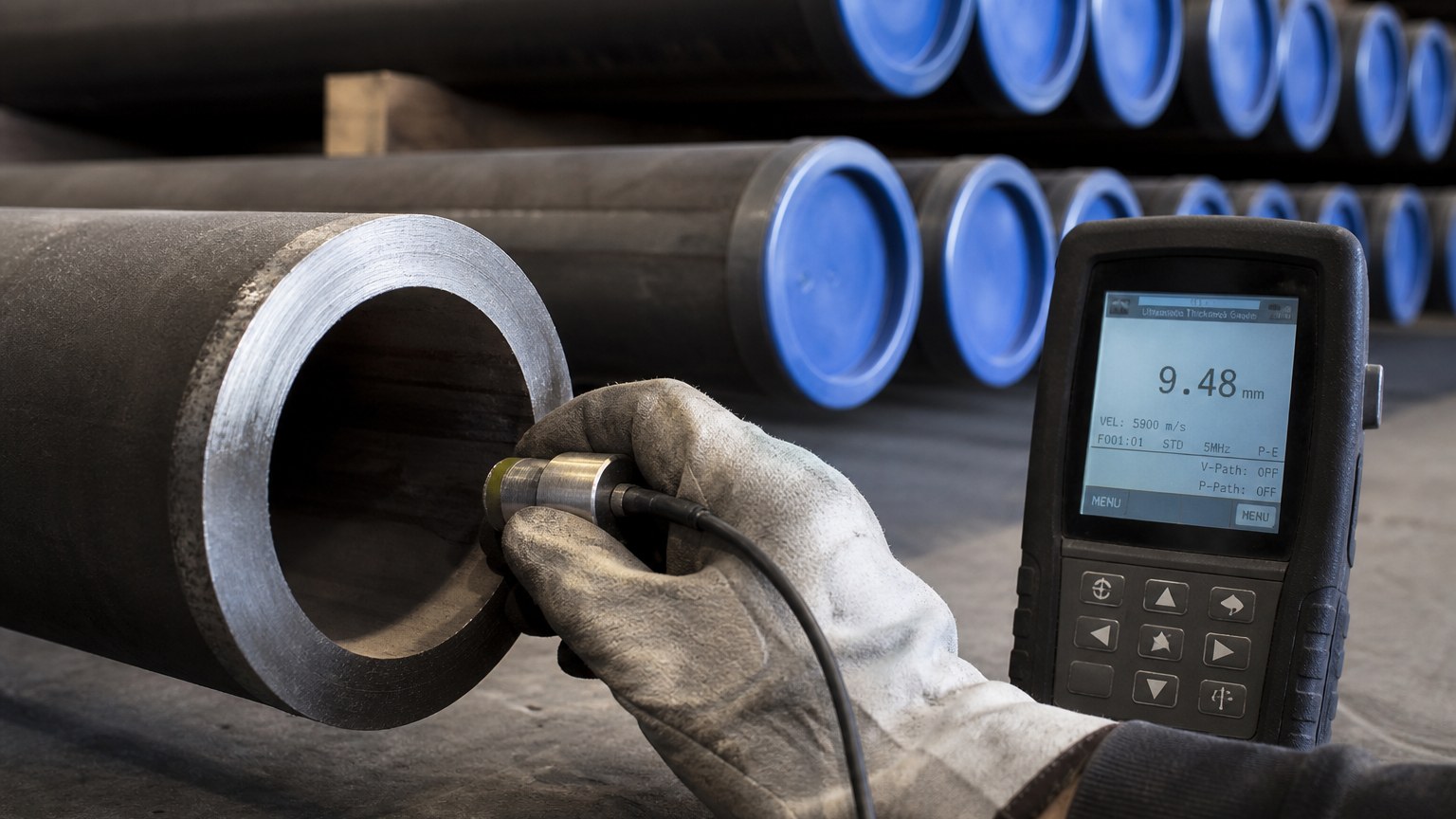
The specification section of a purchase enquiry should be short and complete. It needs the standard and edition, the grade, the product form, the outside diameter and the minimum wall with the tolerance basis stated, the length and straightness requirement, the end finish — plain, bevelled or threaded — the surface condition expected, and the marking and packing requirements. Anything left out will be filled in by the supplier with whatever is normal for their stock, and the difference normally surfaces at goods-in, when the material is already in transit. Inspection is where the order is either confirmed or rejected, and it starts with chemistry, because no later test can repair the wrong heat. A spectrochemical analysis of the finished tube, or positive material identification on a sample, confirms that the chromium and molybdenum in an alloy heat are genuinely present and that a carbon grade has not been substituted. Mechanical testing follows: tensile strength, yield strength and elongation against the grade minimums, plus the flattening, flaring and hardness tests that demonstrate the ductility a tube needs to be bent, expanded into a header and welded without cracking. Dimensional inspection measures outside diameter, wall thickness and length, with wall gauged at several positions around the circumference and the minimum value recorded rather than an average, because it is the thin spot that fails. Non-destructive examination is written into the tube standards and is normally performed as a hydrostatic test or an eddy current test on each tube; where the application is critical, the buyer should say which method is acceptable rather than leaving the choice open. Documentation closes the loop. The heat number, grade, standard and size must be legible on each tube or bundle, and the certificate must trace the delivered material back to the test results for that heat. A 3.1 certificate issued by an independent inspection body is the usual requirement for export power projects and should be agreed at enquiry stage rather than requested after production. Packing deserves a line of its own on long-haul exports, because tube ends are damaged by handling more than tube bodies are, and protective caps, end boards and steel-strapped bundles that keep timber dunnage clear of the tube surface prevent the surface marks that buyers otherwise reject on arrival. If you want these requirements, tolerances and document obligations written onto a quotation before the order is placed, send us the tube schedule and the code edition you are designing to and the specification will be confirmed in writing.
The documents to request with every tube order
- Mill test certificate issued to the standard and edition cited on the order, with heat number, chemistry and mechanical results.
- Hydrostatic or eddy current test report identifying the method applied and the tubes covered.
- Dimensional record for outside diameter, minimum wall and length, including the measurement method.
- Hardness results where the grade or the order carries a hardness limit.
- Heat treatment record showing the condition in which alloy tubes were supplied.
- Positive material identification or spectrochemical analysis result for alloy heats.
- Packing list and marking schedule that matches the tube markings to the certificate.
Conclusion: Superheater and reheater tubes live or die on grade, wall and verification — get the standard, the heat certificate and the wall tolerance right before the tubes are rolled.