
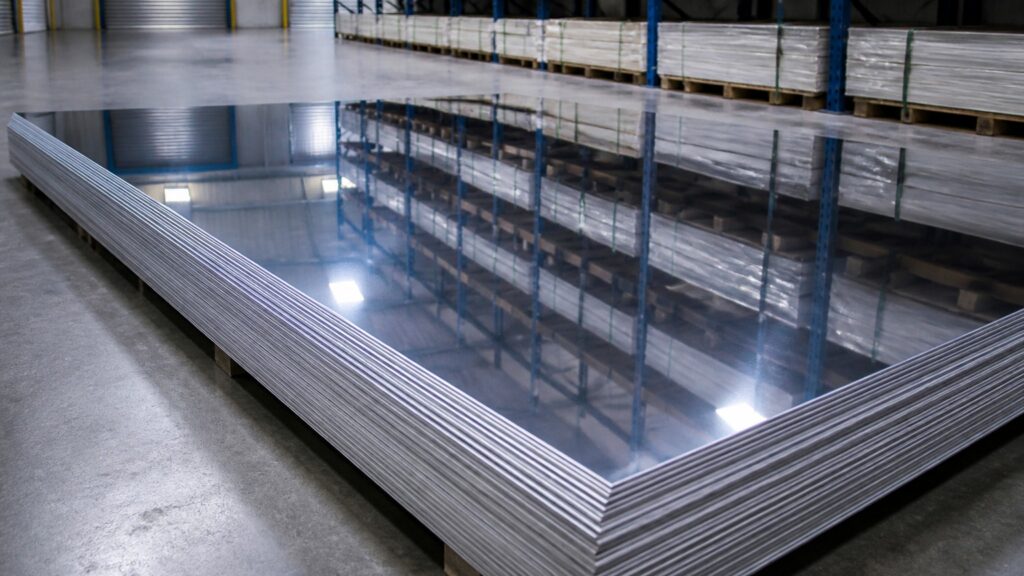
Specifying mirror finish stainless steel from a photo is how projects go wrong. Brightness is not a grade, and a sample that looks perfect can fail on site.
Short answer: Mirror finish stainless steel is sheet or plate that is ground, then polished and buffed with progressively finer abrasives until the surface is non-directional and highly reflective. It matches finish 8 in ASTM A480 and 2P in BS EN 10088-2, typically with Ra below 0.1 micrometre.
That two-line answer settles the vocabulary but not the purchase. A mirror face is the end of a finishing route, not a material in itself, and almost everything that decides whether the delivered sheet matches the approved sample happens after rolling: which grit sequence was run, which grade was chosen as the substrate, how the face was protected during handling, and how the surface was measured before it left the works. The sections below follow the same material through the specification, the polishing line, the grade choice, the applications that actually pay for it, the inspection that catches a bad lot, and the cost drivers that explain why two mirror quotations for the same size can differ by a wide margin.
What Exactly Does “Mirror Finish” Mean in a Steel Specification?
The word mirror is a description, not a standard, and two suppliers can use it for surfaces that differ sharply.
Short answer: In ASTM A480, the brightest mechanically polished flat-product finish is No. 8, a non-directional, highly reflective bright polished surface. BS EN 10088-2 uses the code 2P for the same family, with typical roughness below 0.1 micrometre.
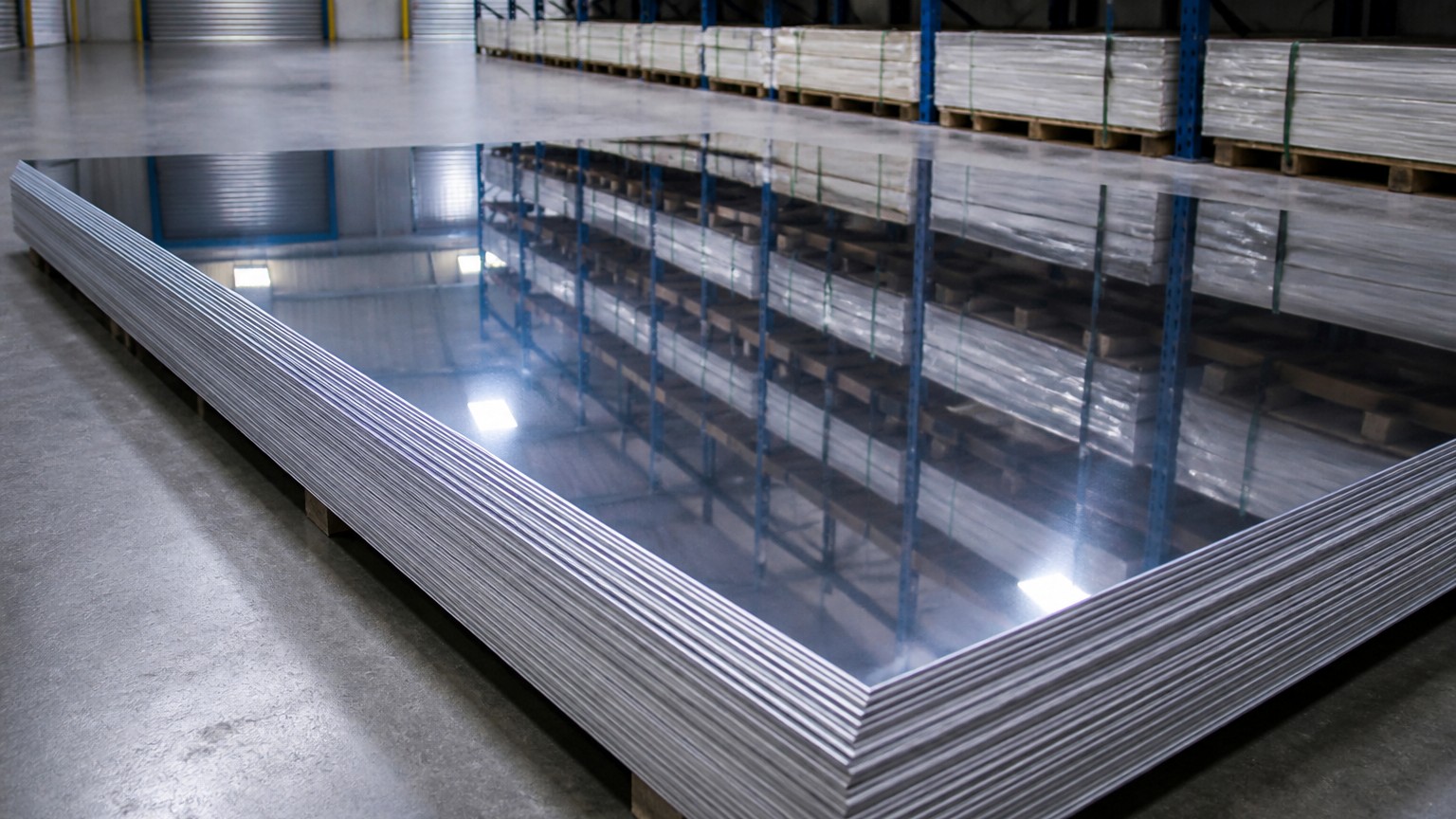
The finishing route behind every code is different, and so is what a buyer can legitimately complain about afterwards. A No. 8 or 2P surface starts from a cold rolled substrate, usually 2B or a bright annealed 2A, and is produced by mechanical abrasion with successively finer grits, ending in a bright, non-directional polish. A No. 7 finish reaches its brightness through buffing on a surface prepared in another way, and the American and European systems do not map onto each other neatly in that region. The British Stainless Steel Association’s comparison of mechanically finished surfaces is worth keeping at hand: it places ASTM A480 No. 8 opposite BS EN 10088-2 2P, both described as cold rolled and bright polished, and it notes that the European standard currently makes no provision for specifying buffed flat products at all. The ASTM A480/A480M general requirements are the reference point on the American side, and they govern dimensions, tolerances, sampling and inspection for the flat-rolled stainless family that includes polished plate.
Why a roughness limit beats the word “mirror”
“Mirror finish” on a purchase order is an opinion; Ra is a measurement. Where the application is decorative and the buyer holds a reference panel, a finish code plus an agreed sample is usually enough. Where the surface has a functional job — a reflected-image panel, a light reflector, a hygienic contact face — an Ra ceiling, a gloss reading and a written inspection method belong in the specification, because those are the numbers an inspector can reproduce on arrival. A sample panel that travels with the order and is signed by both parties closes the remaining gap.
Where the codes stop being useful
Codes describe a finishing route and a roughness band; they do not describe flatness, image clarity, scratch tolerance or colour consistency, and they say nothing about the grade underneath. Two sheets can both be certified as bright polished and still look different under directional light if one carries a slight wave from the coil and the other was polished on a heavier plate. Buyers who need a visually continuous wall should therefore specify the flatness requirement and the maximum reflected-image distortion separately, rather than assuming the finish code covers them. That difference is also a useful lens when comparing 2B vs No.4 stainless steel finishes, where the same logic applies at a lower level of brightness.
How Is Mirror Finish Stainless Steel Actually Made?
Polishing is a sequence of abrasion steps, not a single pass, and the last wheel matters less than the ones before it.
Short answer: The substrate is ground with coarse abrasive from about 80 grit, then polished with progressively finer grits from roughly 120 upward, and finally buffed with cloth or felt mops carrying a fine compound until the surface is bright, smooth and free of visible direction marks.
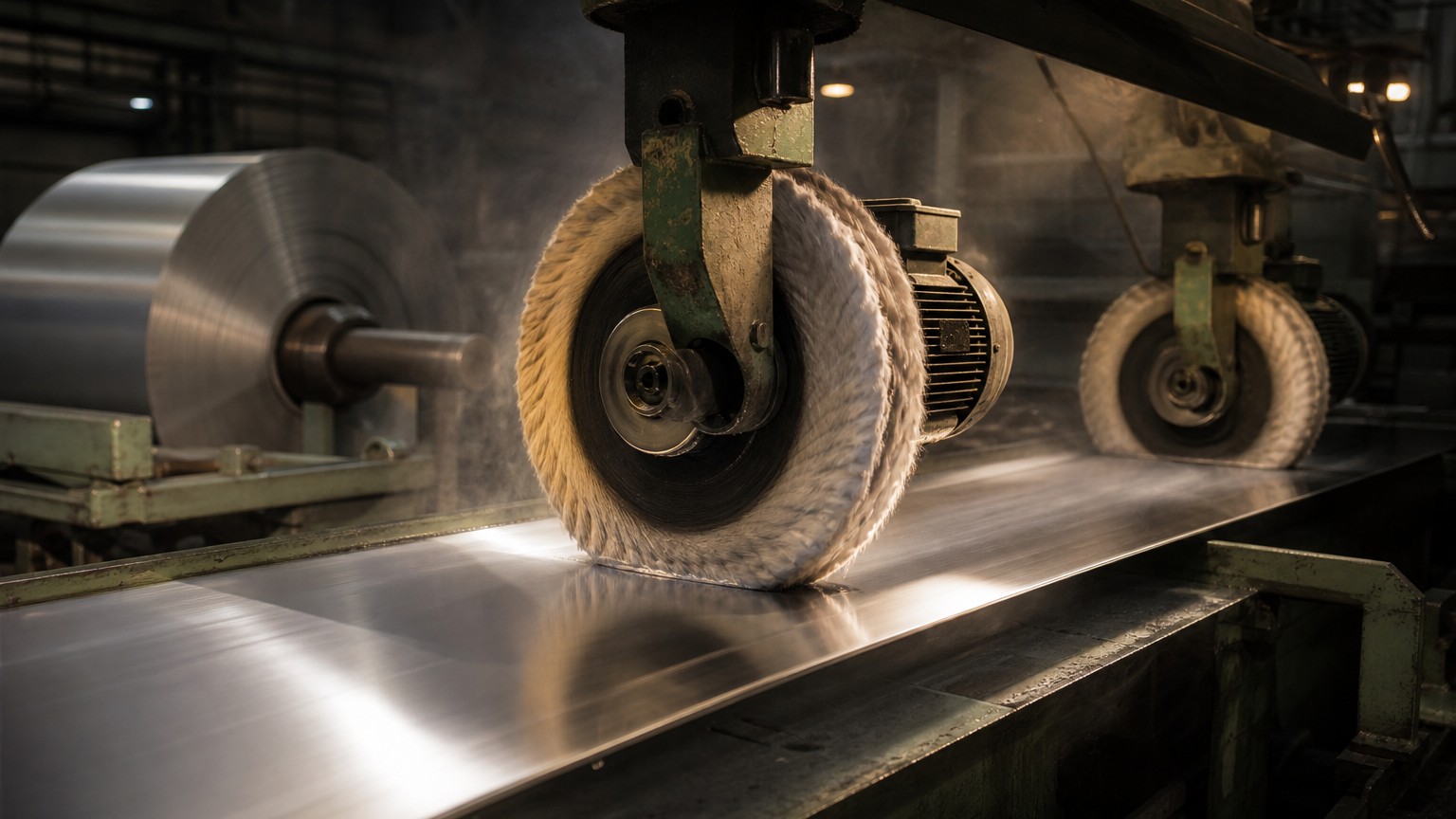
Each stage has one job: remove what the previous stage left behind. Grinding takes out mill scale, pits, roll marks and coil wave at the surface, and it is where the sheet is levelled as much as it is cut. Polishing then replaces each progressively coarser scratch pattern with a finer one, so the sequence matters more than the pressure. Industry guidance draws a rough line at grit 80, treating 80 and coarser as grinding and 120 and finer as polishing, while noting that grit alone never defines the finish — abrasive pressure, contact time, feed rate and whether the operation runs wet or dry all change the surface that results. Buffing is the final step and the one most often misunderstood: it removes no deliberate metal, it smooths and brightens what is already there, and it cannot be used as a shortcut to a polished finish. If a surface arrives at the buffing mop too coarse, traces of the underlying texture stay visible in the finished face.
The sequence on a production line
A typical line runs a sheet or a coil through a series of abrasive heads with steadily finer belts, then through mop stations carrying compound matched to the material. Compounds are graded by their abrasive and by their cutting behaviour: a harder cutting compound removes the pattern left by the belts, while a finishing compound adds colour and depth to the reflection. The technical background on polishing and buffing sets out the two motions used at the mop — a cutting motion that produces a uniform semi-bright surface, and a colouring motion that produces the final bright finish — together with the observation that most mirror-bright results are in fact buffed rather than polished. Much of the work is done under coolant on a wet line, and the sheet is inspected between passes, because a coarser scratch that is covered early still shows up once the reflection sharpens.
What the line can and cannot fix
Polishing changes the surface, not the metal beneath it: a deep dent or a rolled-in inclusion is a downgrade, not a finishing problem. Contamination is the other limit, and it is often self-inflicted downstream. A polishing or brushing tool that has previously been used on carbon steel can leave iron particles on a stainless face, and those particles rust in service and are then read as a grade failure. The BSSA guidance on specifying polished finishes is direct on this point and recommends segregated, clean media for stainless work. On the fabrication side, a polished face also behaves differently from a mill finish, which is why it is worth reading through our notes on how the plate behaves during forming and welding before cutting into a polished lot.
Which Grades Take a Mirror Finish Best?
The substrate decides how clean the reflection can be, and one common alloy family is a poor candidate for bright work.
Short answer: Low-carbon austenitic grades such as 304L and 316L polish most reliably. Titanium-stabilised grades including 321 and 316Ti tend to leave comet-tail defects, and hard martensitic grades are rarely polished to a mirror because the abrasion cost rises sharply.
The reason is metallurgical. A mirror surface reflects every imperfection at the scale of the polishing grain, so a hard second-phase particle sitting in a softer matrix will be torn out of the surface and leave a short comet-shaped trail behind it. That is exactly what happens with titanium-stabilised austenitics, where titanium carbide particles are dislodged during the final stages; finishing guidance recommends moving to the low-carbon equivalents of the same corrosion family instead when a bright polish is required. Carbon content works the other way for a different reason: a lower carbon austenitic is softer and more ductile, so it forms a smoother surface at the abrasive and holds the finish through light forming. Sulphur and other free-machining additions improve machinability but hurt polishability, which is why the free-cutting variants should stay out of bright architectural work.
Choosing between 304L and 316L
Grade selection is then a corrosion decision wearing a finishing hat. In dry indoor service where the surface stays clean and the atmosphere is benign, a 304L substrate is usually sufficient and cheaper to finish. Where the polished face will see chlorides, coastal air, de-icing salts, frequent washing, or process chemicals — dairy and food lines, marine interiors, certain architectural exteriors — the molybdenum-bearing 316L family is the more defensible choice, and the polishing cost is effectively the same. Because the surface is the part that is actually specified, it also helps to keep the substrate consistent: mirror polishing is produced from a flat, uniform starting sheet, which is why a material such as our 316L stainless steel plate in 10 mm No.1 finish is a normal basis for later bright polishing rather than a finished product in its own right.
Hardness, thickness and the cost of the substrate
Thicker material is not harder to shine, but it is harder to keep flat, and each additional polishing pass costs money and removes metal. A 0.8 mm decorative sheet and a 10 mm plate can both reach a bright polish, yet the plate carries more risk of residual stress releasing after the face is finished, which shows up as waviness under a reflected horizon. The familiar grade families — 304, 304L, 316, 316L, 430 and 201 — cover most decorative demand, and the corrosion comparison between them is set out in our notes on the metallurgy of stainless steel, which is a more reliable guide than the marketing name of the finish.
Where Is Mirror Finish Stainless Steel Used?
The paying applications share one trait: they need a surface that stays clean, stays bright, or reflects predictably.
Short answer: It is used for architectural cladding, lift doors and columns, appliance and equipment fascias, food, dairy and pharmaceutical surfaces, light reflectors, retail and signage work, and automotive trim — anywhere appearance and hygiene justify the finishing cost.

Architecture is the largest visible market. Lift doors, lobby wall panels, columns, canopies, entrance surrounds and furniture all take bright polished sheet, and the specifying risk is measured in reflection quality rather than in brightness: a wall of polished panels is a large distorting mirror, so flatness, joint alignment and the orientation of any residual texture decide whether the installation reads as premium or as a funfair mirror. Designers who work with it often pair it with duller finishes to manage glare and fingerprints, which is a practical reason to compare the full family of finishes before committing a façade to a single code.
Functional uses beyond decoration
Hygiene is the second driver. Polished, low-roughness surfaces retain less soil and are easier to clean, which is why bright finishes appear in dairy, beverage, pharmaceutical and food-processing equipment, in kitchen and catering work, and in sanitary installations. A smoother surface with fewer micro-crevices also supports corrosion resistance, because pits and folds are where deposits collect and attack begins. Light reflectors and luminaire surrounds use polished stainless where a durable reflective surface is needed without the fragility of a coating, and automotive trim, appliance fascias, escalator and handrail components, and retail display all draw on the same property: a bright, corrosion-resistant, cleanable face.
Where mirror finishes fail in service
Two failures dominate. The first is installation damage: a bright face shows every handling scuff, and once installed it cannot be re-polished in place as easily as a brushed surface can be re-grained. The second is staining that is mistaken for corrosion, usually iron contamination picked up from carbon steel tools or from dirty finishing media and then rusting on the surface. Both are managed before delivery rather than after, with protective film, careful packing, and fabrication practices that keep stainless away from carbon steel. Buyers sourcing a decorative package usually take the polished face together with a mill finish substrate from the same programme, which is why the mirror finish stainless steel plate range is normally quoted alongside standard 2B and No.1 material rather than on its own.
How Do You Check Mirror Finish Quality Before Buying?
A mirror surface hides nothing, so inspection has to happen before packing rather than on the construction site.
Short answer: Ask for the finish code and an Ra value, inspect under directional light for scratches, comet tails and orange-peel distortion, confirm flatness and edge condition, and require protective film plus a sealed sample panel agreed by both parties.
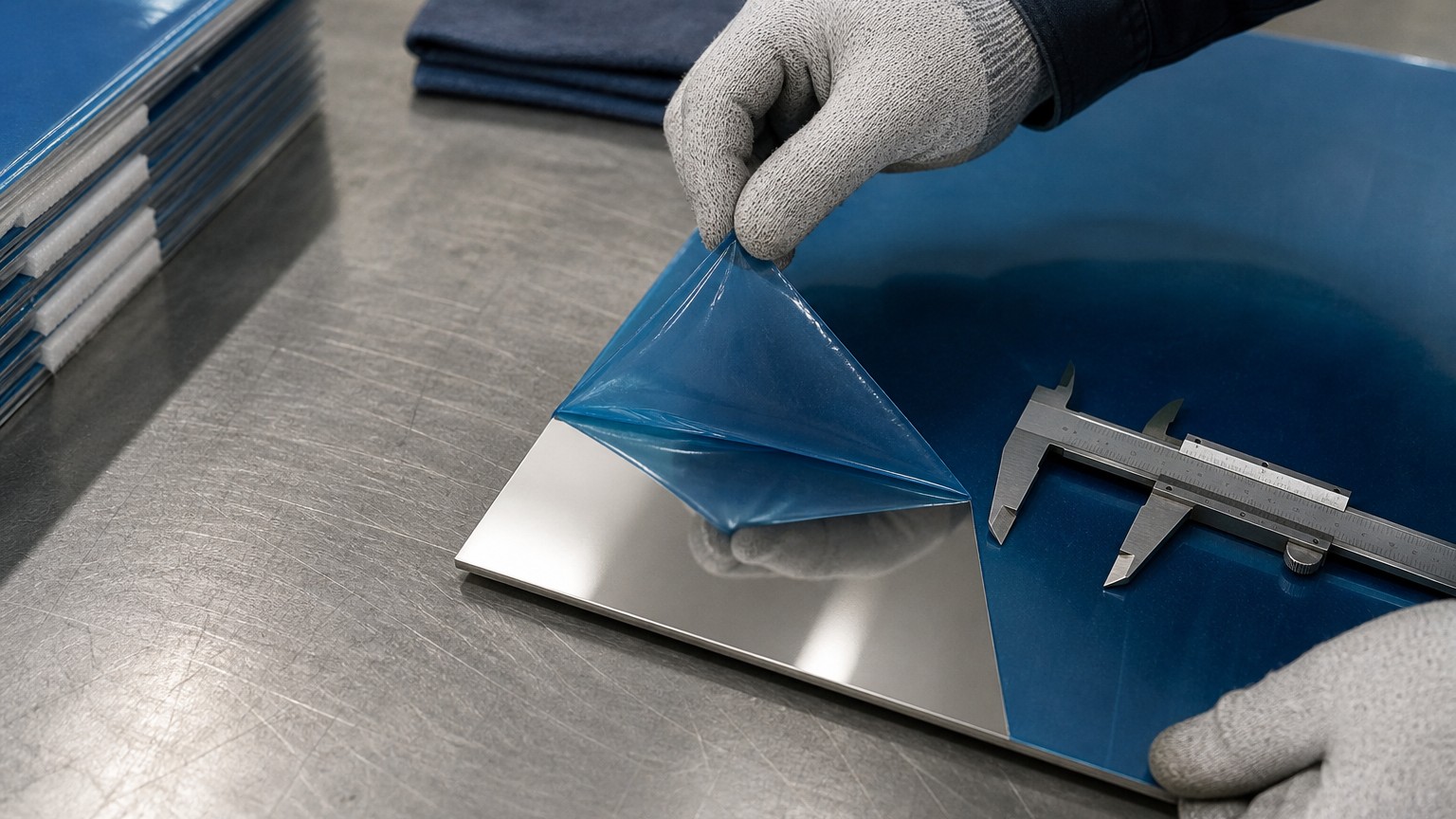
Inspection is easiest to describe as a short routine. Check the certificate first: the finish designation, the grade, the heat number and the mechanical results should match the order, and for flat-rolled stainless plate the product specification behind those results is the ASTM A240/A240M specification covering chromium, chromium-nickel and chromium-manganese-nickel stainless plate, sheet and strip for general and aesthetic applications. Then measure roughness on the delivered face, and inspect visually in the two conditions that expose different defects: bright directional light along the sheet, which reveals polishing direction marks and fine scratches, and a reflected straight edge such as a light column or door frame, which reveals waviness and image distortion that no Ra figure can express.
The defects to look for by name
Orange-peel and wave are flatness and ductility problems rather than roughness problems, and they show up in a reflection before they show up in a number. Comet tails indicate a stabilised grade being polished where a low-carbon grade should have been used. A faint residual direction pattern under a low-angle light suggests an incomplete abrasion sequence, likely a jump between grits. Edge damage, grinding marks near the sheared edge, and handling scuffs under the film are transport and packing issues. On thicker plate, a reflected image that bends across the sheet is usually residual stress releasing after polishing, and it will not improve once the material is cut. Protective film should be applied clean and wrinkle-free, because a trapped particle under film abrades the very face it is protecting.
Making the check enforceable
Verification is only useful if it can be repeated. Write the roughness limit, the inspection light condition, the sample number and the packing method into the order, and keep the approved panel sealed so that both sides judge against the same reference. For first orders, a pre-shipment inspection on the finishing line is inexpensive relative to the value of a rejected façade package, and a supplier who can state the Ra band and the finish code without hedging is normally the one whose delivery matches the sample. If a face must match an existing installation, send us your finish requirement together with a reference photo and the grade, and the polishing route can be fixed before the substrate is cut.
What Drives the Price and Lead Time of Mirror Finish Stainless Steel?
Two quotations for the same size can differ widely, and the gap is almost always in the finishing steps rather than in the metal.
Short answer: Price is driven by grade, thickness, the number of abrasive and mop passes, the starting surface, yield loss from edge trim and rework, protective film and packing, and the risk premium carried by a surface that cannot be repaired invisibly.
Grinding and polishing consume labour and consumables in direct proportion to the area processed and the target brightness, and every additional stage removes metal that has been paid for once already. A sheet that arrives with roll marks, a wave or a heavy scratch needs more passes at a coarser grit than a clean bright annealed substrate, which is why a mill finish in good condition is worth paying for when the destination is a mirror face. Thicker plate takes longer to level and carries more risk of residual stress, and material that fails inspection late in the sequence is scrapped or reworked at full cost, so finishing quotes embed a yield assumption.
Cost elements that are easy to overlook
Protective film is a line item, not a courtesy: a bright face requires a clean applied film and proper interleaving, and packing has to prevent panels rubbing in transit. Sheet size and shape matter because an odd size produces more trim waste from a standard sheet. Order quantity changes the setup economics, since a small lot and a full line run share the same preparation but not the same volume of saleable output. Grade shifts the metal cost without changing the finishing cost, and the roughness target is a direct cost lever: a satin or dull polished surface is measurably cheaper to produce than a bright polished one, because it stops several stages earlier. Lead time follows the same logic — the finishing line is a sequential process limited by its slowest station, so a rush order either displaces another lot or moves to the back of the queue.
How to buy it without surprises
The most effective cost control is a precise order: grade, finish code, Ra ceiling, thickness and tolerance, sheet size, edge condition, film, packing, and an agreed inspection basis. Ambiguity is expensive on a polished product because every disagreement is settled by re-polishing or replacing, both of which cost more than the original finishing. Buyers who need a decorative face combined with structural material in the same shipment usually get better economics by fixing the finish on one line of the order and taking the balance in mill finish, rather than by polishing everything.
Conclusion: Is Mirror Finish Stainless Steel Worth the Extra Cost?
Mirror finish is a specified surface, not a mood: fix the finish code, Ra limit and grade, protect the face, and inspect before shipment.