
Boiler Tube Heat Treatment: Normalizing, Annealing or Stress Relief — Which Do You Need?
Wrong heat treatment quietly destroys boiler tube life. Specify the wrong cycle and creep strength, ductility and weldability all suffer before the first hydrostatic test is even run.
Short answer: Normalizing is applied to as-rolled tube to refine grain structure; full annealing softens tube before cold drawing or heavy forming; stress relief removes residual stresses at subcritical temperature without deliberately changing the microstructure. Most boiler tube standards name the acceptable condition.
Transition: Heat treatment is the least visible stage in a boiler tube’s life. It leaves no mark on the tube, it cannot be judged from a photograph, and it is nearly impossible to assess on delivery without documentation — yet it decides whether the tube you bought actually holds the elevated-temperature properties your design code assumes. The sections below work through the three cycles that dominate boiler tube supply, the temperature ranges and cooling paths that define each one, how the standards pin the choice down, and the tests that prove the cycle was really performed.
What Is Boiler Tube Heat Treatment, and Why Does It Matter?
Heat treatment is not an optional finishing step. It is the stage that decides whether a tube meets its design-temperature properties.
Short answer: Boiler tube heat treatment is controlled heating and cooling that develops the mechanical properties the design code requires. It refines grain structure, removes residual stress and restores the ductility lost during piercing, rolling and welding.
Dive deeper: Start with where the tube has been. A seamless boiler tube is not born as a tube. It begins as a round billet, is heated to forging temperature, pierced into a hollow shell, then rolled, sized and straightened. Each of those operations leaves something behind. Piercing and rolling produce a worked, non-uniform grain structure and substantial internal stress, and sizing and straightening add more. Shipped in that condition, the tube would show inconsistent hardness along its length, unpredictable behaviour in the bending shop and, in high-temperature service, a structure that coarsens and degrades faster than it should. There is a commercial dimension to this as well. Property variation along a length of tube cannot be detected by the buyer on arrival, so it is never corrected later — it simply surfaces as a bend that springs back differently than the sample did, a weld that behaves inconsistently from one joint to the next, or a tube that fails a test the fabricator was not expecting to run. Heat treatment is therefore the stage where a mill converts a physically plausible tube into a specification-compliant one, and it explains why boiler tube specifications are written around a delivered condition rather than around chemistry alone. When two offers name the same grade, the same outside diameter and the same wall, the heat-treatment condition is frequently the only substantive difference between them — and it is the line that decides what the tube does after ten thousand hours at temperature rather than what it measures on the day it is unloaded from the container.
The mechanism is well documented. As reference material on heat treating sets out, a metal consists of a microstructure of grains, and the size and composition of those grains is one of the most effective factors governing overall mechanical behaviour. Heat treatment manipulates that structure by controlling diffusion and cooling rate. Two mechanisms do the work: the formation of martensite deforms the crystal lattice, while diffusion changes how homogeneous the alloy is. For boiler tube, the interesting part is the second one, because boiler service is decided by what happens at temperature over tens of thousands of hours, not by peak strength on the day of delivery.
Why the mill cannot skip it
Three practical reasons keep heat treatment in the route. First, dimensional stability: a tube carrying locked-in stress will move when it is cut, bent or welded, and boiler fabrication tolerances do not absorb that movement. Second, consistency: a customer welding hundreds of tubes into a water wall needs every metre to behave like the last one, and only a controlled thermal cycle delivers that. Third, code compliance: boiler construction codes list which tube specifications may be used, and those specifications normally require the finished tube to be supplied in a specified heat-treated condition with the corresponding tests. A mill that skips the cycle cannot legally issue the certificate the project needs.
What the buyer is actually buying
This is why high-pressure boiler steel pipe is quoted with a condition, not just a grade. Two offers can name the same grade, the same outside diameter and the same wall, and still differ in what the delivery will do in service, because one was normalized and one was not, or because the cooling path was uncontrolled. The condition is a specification line, and it belongs on the enquiry next to the grade and the dimensions.
How Does Normalizing Work on Seamless Boiler Tube?
Normalizing is the default treatment for as-rolled seamless tube, and for many boiler grades it is the condition the standard assumes.
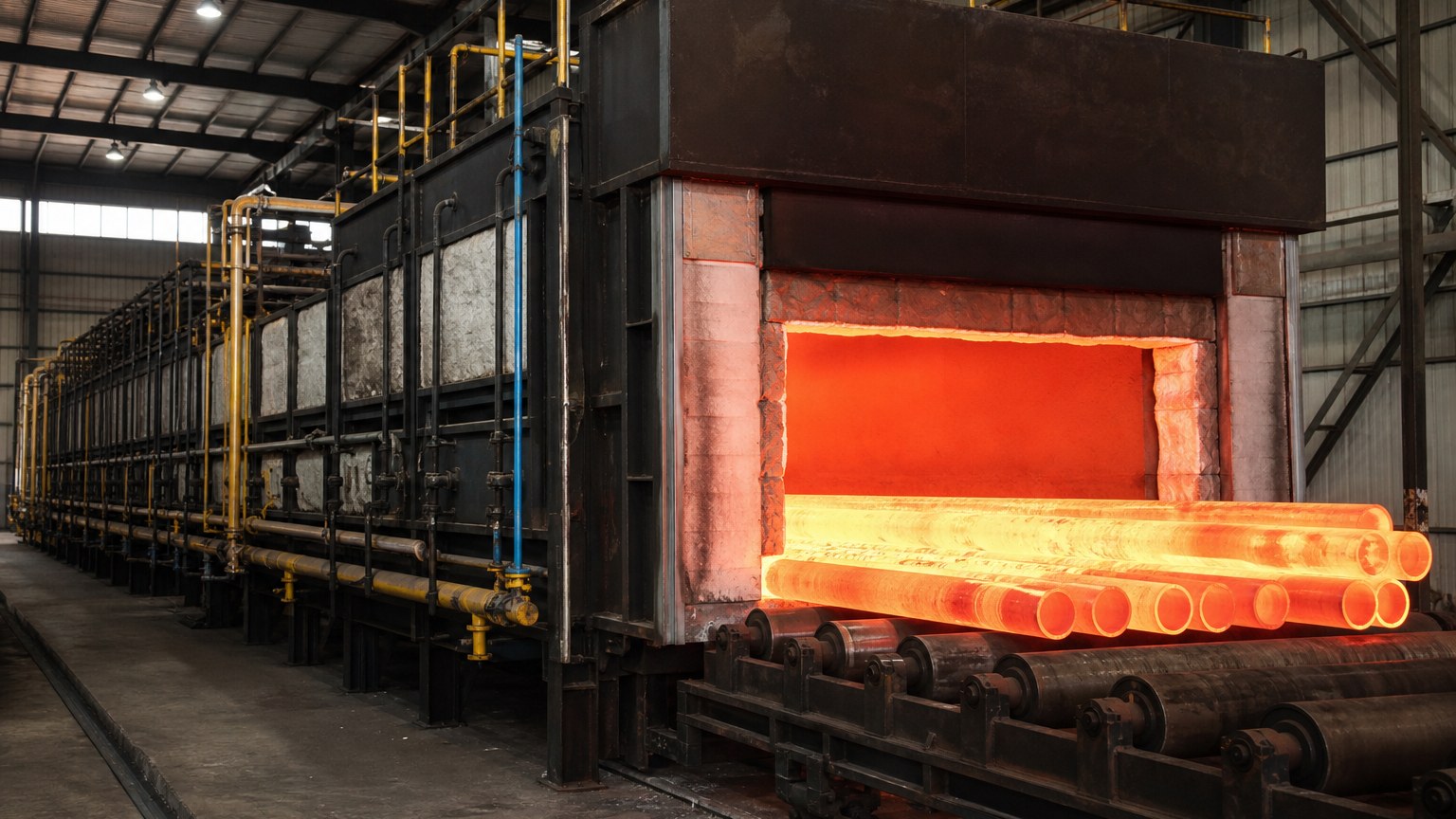
Short answer: Normalizing heats tube above its upper critical temperature, holds it long enough for the structure to become fully austenitic, then cools it in still air. The result is a finer, more uniform grain structure with better ductility and more predictable hardness than the as-rolled condition.
Dive deeper: The cycle has three variables, and each one has to be controlled: austenitizing temperature, holding time and cooling rate. For the carbon and low-alloy grades used in boiler and superheater service, the austenitizing temperature is commonly quoted in the region of 900 to 950 °C, but the correct value is the one the applicable product specification and the mill’s qualified procedure call for, because it depends on the carbon content and alloying additions of the grade in question. Heat the tube too low and the transformation stays incomplete, leaving bands of untransformed structure. Heat it too high and the austenite grains grow, which coarsens the final structure and costs toughness — the reason good practice is to work just above the critical temperature rather than comfortably above it. Holding time is the second variable. The tube has to be held long enough for the centre of the wall to reach temperature, which is a function of wall thickness and furnace behaviour, not a fixed number of minutes, so a heavy-wall tube and a thin-wall heat-exchanger tube made from the same grade do not share a soak time. Cooling rate is the third, and in a normalizing cycle it is decided by how the charge is presented to the air. Bundle spacing, fan arrangement and even ambient conditions influence how fast a given tube actually cools, which is why a mill that stacks a full charge tightly and calls the result normalized is not delivering the same product as one that controls the cooling step and records it.
Why air cooling, not quenching
Cooling in still air is what makes normalizing normalizing. The air-cooling rate is fast enough to produce a fine pearlitic structure with higher strength than a fully annealed tube, but slow enough to avoid the hard, brittle martensite that quenching would create. For boiler tube the objective is a structure that combines adequate strength with the ductility needed for bending and expanding into a tube sheet, so a hard transformation product would be counterproductive. Air cooling also keeps distortion manageable, which matters for tube that has to fit a fixed tube pitch.
Where normalizing sits in the production route
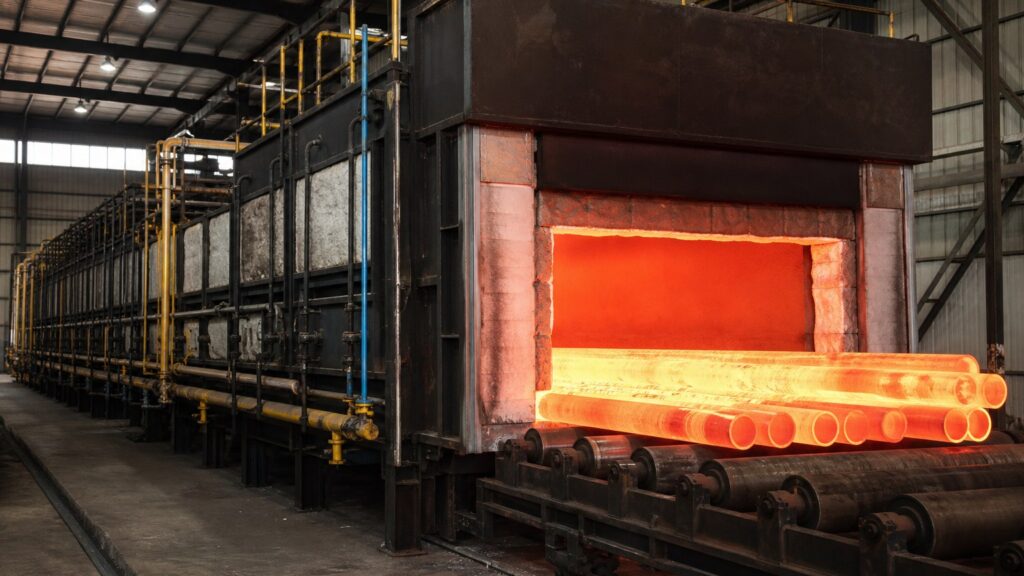
In practice the tube leaves the rolling line, is cut to length, and enters the heat-treatment furnace before final straightening, inspection and testing. Understanding this sequence helps when you audit a supplier, because the position of the furnace in the route determines what the final properties can be. A tube normalized and then straight-rolled with the wrong parameters can still be delivered with stress locked back in. Anyone who wants to see the whole route — from billet to finished tube — can read how the material is produced in our guide to how seamless tube is made before visiting a mill.
When Should Boiler Tubes Be Annealed Instead?
Annealing is chosen when the tube has to become softer or more formable than normalizing can deliver.
Short answer: Full annealing heats tube above the critical temperature and cools it slowly inside the furnace, producing a soft, coarsened structure with low hardness. It is used before cold drawing, heavy cold forming or machining, and wherever hardness limits are tighter than normalizing can meet.
Dive deeper: The difference between normalizing and annealing is almost entirely about cooling. Both take the tube above the critical temperature; the anneal then removes it from the furnace environment as slowly as practical, often by leaving it in the furnace or by controlling the cooling rate to a few tens of degrees per hour down to a low temperature. That slow path gives the carbon far more time to diffuse, producing a coarser, softer structure with lower hardness and higher ductility than air cooling would leave. For a general account of what the cycle does to structure, reference material on annealing in metallurgy covers the underlying transformations. The practical consequence is a trade rather than an upgrade. An annealed tube cold forms and machines more easily, but it is also weaker at room temperature than the same tube normalized, and its structure is coarser, which is why annealing is specified for a purpose — the next operation — and not as a general quality improvement. Where the geometry is awkward or the drawing reduction is severe, the anneal is what makes the next pass possible at all. Where the tube is going straight into a boiler water wall, annealing would strip useful strength for no benefit and add cost. Buyers who ask for annealing without being able to say why often find they have paid more for a tube that runs slower on the forming line and carries lower tensile figures than the normalized equivalent would have.
Furnace cooling is the whole point
Because the cooling rate is the controlling variable, the annealing furnace and its control system matter more than the nominal temperature. A furnace that cannot hold a slow, uniform cooling ramp across a full charge will produce a load with hardness varying from bundle to bundle. This shows up later as inconsistent behaviour in a drawing line or a machining cell, and it is one of the reasons buyers ask for hardness results per heat rather than a single value.
Where annealing appears in the boiler supply chain
Annealing is most common downstream of the tube mill. Cold-drawn and cold-finished tube is drawn in successive passes, and the steel work-hardens with each pass; between passes it must be annealed to restore ductility or it will crack. Precision cold-drawn tube for boiler and heat-exchanger applications therefore carries an annealing step that is not optional but structural to the process. Annealing also appears before heavy cold forming operations, and where a customer needs to machine a component from tube stock and wants a soft, stable structure to work with. In contrast, a plain hot-rolled and normalized boiler tube that is going straight into a water wall does not normally need an anneal at all — adding one would only raise cost and soften the tube. The choice follows the next operation, which is why the correct question is not “which cycle is better” but “what happens to this tube next”. If you want the cycle requirements mapped against specific grade designations, our breakdown of boiler tube heat treatment conditions by standard and grade is a faster route than working through each specification separately.
What Is Stress Relief, and When Is It Required?
Stress relief is the mildest of the three cycles, and the one most often confused with a full heat treatment.
Short answer: Stress relief heats tube below its lower critical temperature, holds it, then cools it slowly enough to relax residual stresses. It does not deliberately change the microstructure, and it is used after cold working, machining, bending or welding.
Dive deeper: The defining feature of stress relief is that the metal never transforms. Heating stays below the lower critical temperature, so the structure the tube already has is retained; only the internal stress state changes. That distinction matters commercially as well as metallurgically, because stress relief cannot be used to repair an inadequate as-rolled structure. If a tube was never normalized, stress relieving it will not make it normalized, and a certificate showing a stress-relief cycle says nothing at all about grain refinement. What the cycle does deliver is dimensional and structural stability. Residual stresses from cold drawing, machining, bending or welding sit balanced inside the material, and when a later operation removes material — a cut, a groove, a weld preparation — that balance is disturbed and the part moves. Relaxing the stresses before final machining keeps dimensions where the drawing puts them, and it reduces the risk of stress-corrosion cracking in service, which is a genuine concern in steam and condensate environments. Because the cycle is mild, the strength penalty is small, which is why it is normally applied once the geometry is essentially final. Applying it too early — before a heavy forming pass, for example — wastes the cycle entirely, because the forming operation simply reintroduces the stresses that were just removed.
Below the critical temperature, on purpose
Typical stress-relieving temperatures for carbon and low-alloy boiler grades sit well below the transformation range, and the exact figure is set by the product specification, the grade and how much strength the customer is prepared to trade away. Holding time again depends on wall thickness, and cooling is slow and controlled so that no new stresses are introduced on the way down. Because the cycle is mild, the property change is small and predictable, which is exactly why it is used late in the process, after the geometry is essentially final.
Field and shop cases that require it
On the fabrication side, stress relief follows welding of heavy sections, tube-to-header joints where the design code requires it, and any cold bending operation beyond a modest radius. It also appears after machining of tube-sheet holes and after any operation that removes material unevenly. The list is set by the construction code and the engineering specification rather than by preference, and it is normally recorded as a distinct item in the inspection and test plan. For a heat-treatment condition to be meaningful, though, it has to be demonstrated, and that is where testing and documentation take over.
How Do You Verify That Heat Treatment Worked?
A heat-treated tube looks exactly like an untreated one, so verification is entirely a question of testing and documentation.
Short answer: Verification combines hardness and tensile testing with ductility tests such as flattening, flaring and bend, plus a mill test certificate that ties every result to the heat number and states the heat-treatment condition supplied.
Dive deeper: Chemical analysis comes first, because the grade limits on carbon, manganese, phosphorus and sulphur are what make the specified heat treatment capable of producing the required properties in the first place. Chemistry alone proves nothing about the cycle, however. Hardness is the fastest indicator that something has gone wrong, because an under-treated or over-treated tube usually departs from the expected hardness band well before it fails a tensile test. A tensile test then confirms that yield strength, tensile strength and elongation fall inside the grade limits, and ductility tests specific to tubular product — flattening and flaring — demonstrate that the tube can survive the bending and expanding operations that boiler fabrication will impose on it. The applicable specifications require precisely this combination. The specification for seamless ferritic and austenitic alloy-steel boiler, superheater and heat-exchanger tubes, ASTM A213/A213M, covers product intended for high-temperature service and requires the finished tubes to be heat treated, with testing and hardness requirements attached to the grades it lists. Referencing the standard is not pedantry; it is the only reliable way to know which tests are mandatory for the grade and size you have ordered, and which are optional extras a supplier may or may not have performed.
Hardness is the fastest screen
Hardness testing earns its place because it is quick, cheap and spatially informative. Sampling several tubes from a charge rather than one gives a picture of how uniform the furnace load was. A tight cluster of values suggests a well-controlled cycle; a wide spread suggests uneven heating or uncontrolled cooling, even if every individual value happens to sit inside limits.
What the certificate must say
Three checks catch most problems before a shipment leaves. First, confirm the specification number, edition and grade on the certificate match the purchase order exactly. Second, confirm the manufacturing route is stated as seamless where the order requires it. Third, confirm the heat-treatment condition is stated explicitly and that the test list covers everything the standard requires for that grade and size. Where a standard permits alternatives — hydrostatic testing or a nondestructive electric test, for instance — the certificate has to show which option was actually performed. A certificate that lists results without naming the condition is incomplete for a boiler application, however good the numbers look.
Which Standard Decides the Heat Treatment Cycle for Your Order?
The cycle is not the buyer’s free choice. It is the condition each product standard permits or requires for the grade and size ordered.
Short answer: ASTM A213, A210/A210M, A106, GB 5310 and EN 10216-2 each set heat-treatment conditions and test requirements for the products they cover. Confirm the edition, grade and size first, then let the standard fix the cycle.
Dive deeper: Boiler tube specifications are written around the service they serve, and heat treatment is one of the levers they use to make that service achievable. A specification written for high-temperature service will require a heat-treated condition and will attach hardness or tensile requirements to the grades it lists, because those properties are what elevated-temperature service depends on. A specification written for heat-exchanger or low-temperature duty may allow different conditions, because the risk profile is different. This is why the same nominal grade can be supplied in more than one condition, and why the condition must be quoted rather than assumed. The second layer is the design code. Material specifications describe what a tube can be, but the construction code decides which of those specifications may be used for the pressure part in question and under what temperature limits. For medium-carbon boiler and superheater tube, the applicable product specification defines the grades together with the associated chemical and tensile requirements and requires dimensional and mechanical checks on the finished product, as the scope of ASTM A210/A210M sets out. Read the scope first and the individual requirements second; conflating the two is a common source of rework. Editions matter as well, because standards are revised and a hot-rolled condition permitted in one edition may be treated differently in the next, so the purchase order should name the edition the project was designed against rather than leaving the mill to choose.
Where the standards agree, and where they do not
Across the ASTM, GB and EN families the same principles recur: the tube must be supplied in a controlled condition, the condition must be recorded, and the mechanical properties must be demonstrated on the finished product. Where they diverge is in the detail — which grades may be supplied as-rolled, which require normalizing specifically, which permit stress-relieved rather than fully heat-treated condition, and how hardness limits are expressed. Those differences are not translations of one another, and a supplier should be able to state the standard, edition, grade and condition the offer is made against.
Putting it on the order
Fix five things before requesting quotations: the standard and grade with edition; the outside diameter and schedule or wall thickness; the required heat-treatment condition; the test package including whether third-party witnessing is wanted; and the quantity. Where the order calls for a specific size in a boiler grade, a product page such as our SA-106 Gr.B boiler steel tube in 3 inch shows how those specification lines are assembled in practice, and if you would rather have the specification reviewed before you issue an enquiry, you can send your tube specification to our engineering team and we will confirm the standard, condition and test package that apply.
Conclusion: Normalize as-rolled tube, anneal before cold drawing or heavy forming, stress-relieve after forming or welding — then prove the cycle with hardness, tensile and ductility results on the certificate.